

On why sixteen is the number that feels right – in mathematics, design, collecting, and the occasional pub quiz.
There is a number that is simultaneously its own perimeter and its own area. A square with sides of four has a perimeter of sixteen and an area of sixteen. It is the only integer for which this is true. Mathematicians call it a curiosity. Designers call it a grid. Collectors call it a complete set.
Sixteen has a quiet authority that reveals itself slowly. It is not a dramatic number. It does not demand attention. But look closely and it turns up everywhere – in art, in nature, in technology, in play – and always for the same underlying reason: it is perfectly ordered without being rigid, complete without being closed.
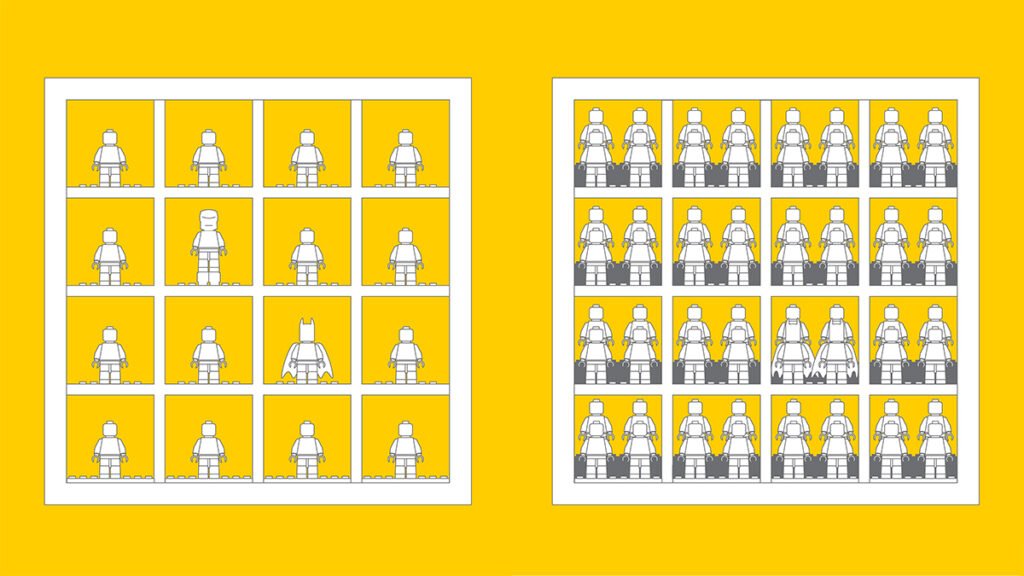
Finity Frames is purposefully designed around a 4×4 grid of sixteen spaces.
The Number LEGO Already Knew
When LEGO® launched its Collectible Minifigures series in 2010, each series contained – yes – sixteen minifigures. This was not a coincidence. Sixteen is divisible by 1, 2, 4, 8, and 16 itself – making it unusually flexible for product planning, retail packaging, and collector completionism. You can collect in pairs, in fours, in eights, or go for the full sixteen. Sixteen also fits into LEGO’s own design aesthetic with the 2×4 brick the centre piece.
On the occasions LEGO varied the formula – releasing CMF series of twelve or twenty figures – they remained faithful to the same underlying logic. Both twelve and twenty are divisible by four. The 4×4 structure was the constant, even when the total varied. LEGO understood, perhaps instinctively, that collectors think in fours.
Of course, there are outliers, such as the limited edition CMF Series 10 Mr Gold who bumped up that collection from 16 to 17.
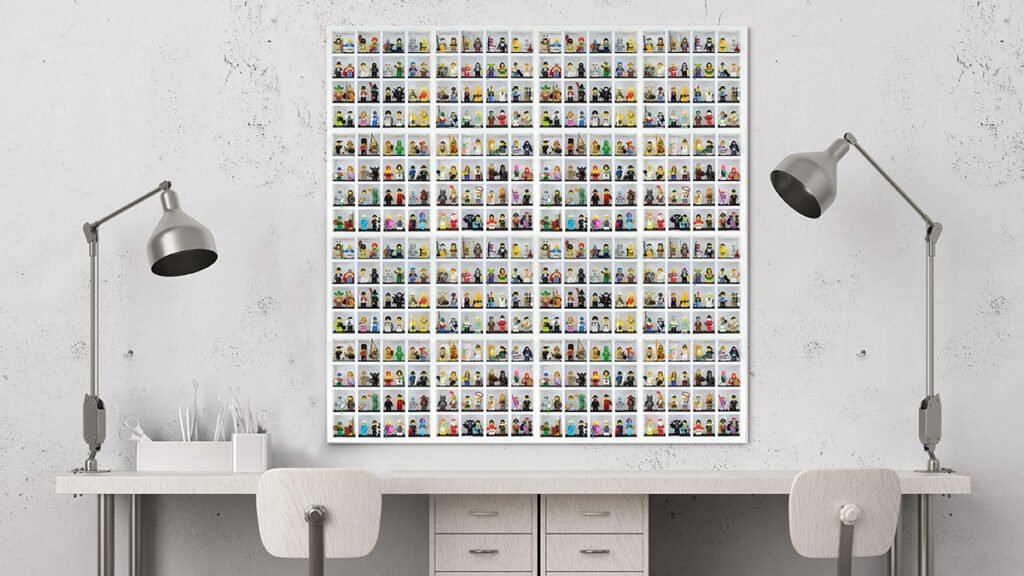
Finity Frames is built around that same logic. Each space in a 1×1 frame holds one complete CMF series. A 2×2 frame holds four series. A 4×4 frame holds sixteen complete series – 256 minifigures, arranged in a grid that feels, as it should, exactly right.
Why 4×4 Feels Right on a Wall
The appeal of the 4×4 grid begins with its perfect geometry. Unlike a 3×3, which pulls the eye toward a single dominant centre point, a 4×4 distributes emphasis evenly. There is no hierarchy. The eye moves across the surface in a rhythm rather than being drawn inward to a focal point. This makes it ideal for collections, serial works, or objects that are meant to be read together rather than individually elevated.
Sixteen items are also precisely the right quantity for comfortable viewing. Enough to suggest abundance and depth, but not so many that the viewer loses orientation. In a living room or home office, a 4×4 grid invites a particular kind of attention: step back and take in the full pattern, then step closer to engage with individual elements. This oscillation between macro and micro is central to the pleasure of display. The grid becomes a framework for how time is spent with the work.
In galleries, this structure has long aligned with conceptual and minimalist traditions. Artists working in series – photographers, printmakers, conceptual painters – frequently use grids to emphasise process, variation, or repetition. When the format is consistent, content carries the meaning. Subtle shifts in colour, expression, or detail become more legible within a disciplined structure. Sixteen works presented together suggest rigour and completeness, as if an idea has been fully explored.
The grid itself carries historical weight. From Renaissance perspective systems to modernist abstraction, grids have long been associated with rationality and structure. The 4×4, in particular, sits at an intersection between the human and the systematic. It echoes architectural logic – windows, tiles, shelving – making it intuitively readable in both domestic and institutional spaces. This familiarity is part of why sixteen feels right on a wall, whether in a gallery or a home.
The Digital Dimension
There is also a digital resonance to sixteen that quietly shapes how contemporary audiences perceive it. In computing, powers of two dominate structure and logic, and sixteen – being 2 to the power of 4, or 4 to the power of 2 – carries an implicit sense of completeness and resolution. It is the base of the hexadecimal system. It is how computers think.
This may unconsciously influence how we respond to grid-based layouts in visual culture. Screens, thumbnails, photo grids, and social feeds all rely on structures derived from powers of two. The 4×4 arrangement feels modern without being cold, structured without being sterile. It speaks a visual language that contemporary audiences already know.
The Mathematics of Sixteen
The mathematical properties of sixteen reward a closer look. It is a perfect square (4²) and a perfect fourth power (2⁴) simultaneously – the only number, other than 1, that satisfies both conditions. Its divisors are 1, 2, 4, 8, and 16: a clean, complete set. It is the base of hexadecimal, the numbering system at the heart of modern computing.
And then there is that curiosity mentioned at the outset: sixteen is the only positive integer that is simultaneously the perimeter and the area of a square with integer sides. A square with sides of four has a perimeter of 16 and an area of 16. It is, in a precise mathematical sense, the number most in harmony with itself.
A Stage, Not a Performance
The aesthetic strength of sixteen lies in its restraint. It does not demand attention through symbolism or spectacle. Instead, it offers a quiet framework that allows content to speak clearly. In art and display, the 4×4 grid becomes a stage rather than a performance – an architecture of viewing that supports meaning rather than competing with it.
In a world saturated with images, sixteen reminds us that how things are arranged can be just as powerful as what is being shown.
16, 32, 48, 64
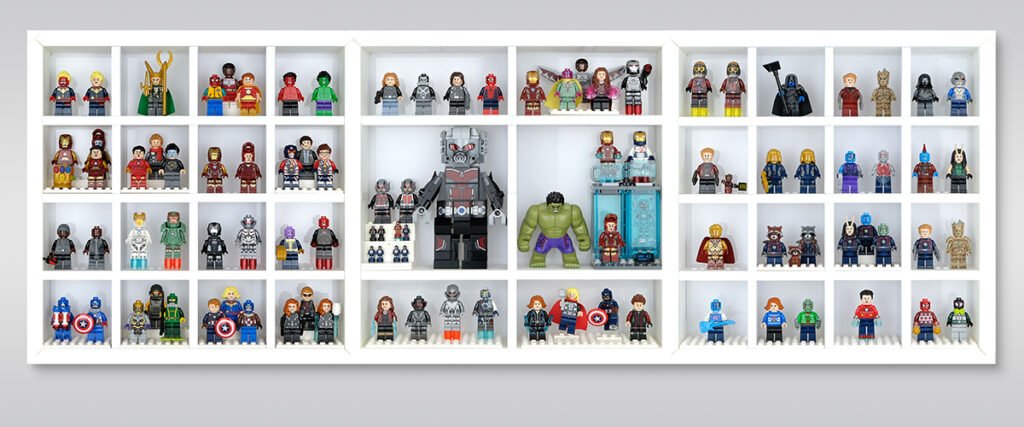
These are the standard number of minifigures that fill each Finity Frame.
64 is also the exact internal dimension of each of the 16 spaces – 64mm × 64mm. The same frame has 64 internal configurations using the six slats. And 64 is 2⁴ – the same mathematical family as 16, the number the whole system is built around. There will be questions at the end!
At its most ambitious, the logic of sixteen scales to something (almost) monumental. A 16×16 Finity Frames installation – 256 connected frames – holds up to 16,384 minifigures at four per space. Remove the vertical slats and that jumps up to 88 minifigures per frame – 22,528 in total. That’s enough to display not only every LEGO® minifigure and minidoll ever released*, but have tonnes of space left over for years of future releases.
Arranged across roughly five metres square, it would be less a display and more an installation – the kind of thing you’d find in a gallery, or at the entrance to a museum dedicated to five decades of the world’s most collected figure.
Sixteen, taken to its logical conclusion, contains everything.
Pub Quiz Sixteens
• The number of legs most species of caterpillar have – not 100, despite the name.
• Legal drinking age in Portugal, Austria, Switzerland, Germany, and Belgium.
• Driving licence age in Australia, New Zealand, Iceland, South Africa, Canada, and the USA.
• Roman numerals: XVI
• What the binary number 10000 equals.
• Hexadecimal: 10 – because in base 16, the second positional column represents 16¹ = 16, just as in decimal the second column represents 10¹ = 10.
• On the periodic table, sulphur has atomic number 16 and belongs to Group 16 – the chalcogens, or oxygen family.
• In Myers-Briggs, there are exactly 16 distinct personality types.
• In chess, each player begins with 16 pieces – including 8 pawns, which together make 16 pawns on the board.
• In some countries, especially the United States, ‘Sweet Sixteen’ marks a girl’s sixteenth birthday – a coming-of-age celebration.
| Sixteen is, it turns out, a very considered choice. Not just because it fits a complete CMF series, or because 4×4 is satisfying to look at, or because the mathematics are quietly extraordinary. But because the right number, properly displayed, becomes something more than the sum of its parts. That’s what good display does. That’s Finity Frames in a nutshell. |