

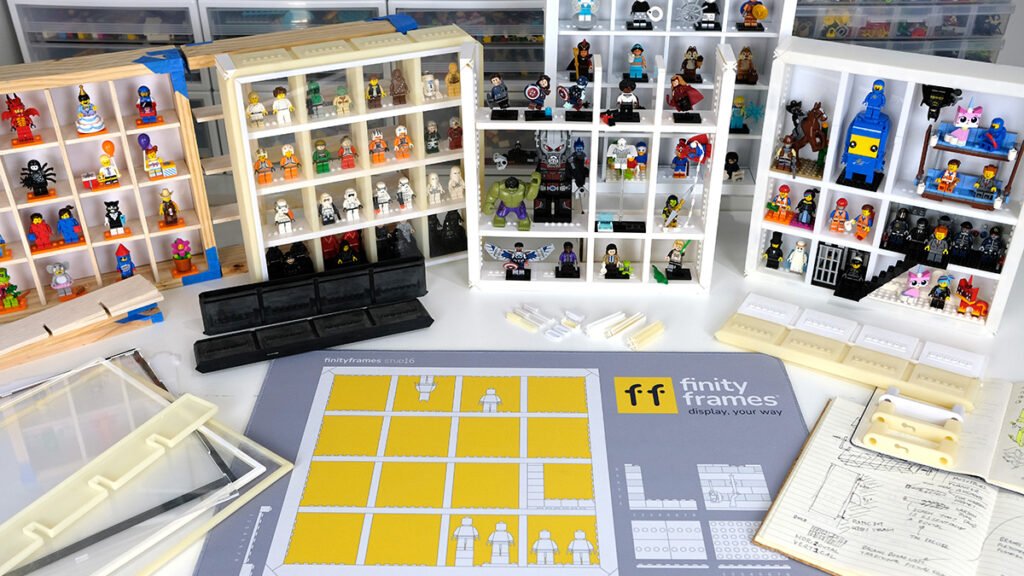
On the chain of discoveries – from a balsa wood prototype to a patented system – that made Finity Frames genuinely part of the LEGO® System of Play.
The decision to build around a 4×4 grid of sixteen spaces was, as described elsewhere, both aesthetically and mathematically deliberate. But it was also the beginning of a longer process – a chain of discoveries, each one unlocking the next, that took Finity Frames from a display frame into something more considered.
Each step in the design asked the same question: does this work within the LEGO System of Play? Not approximately. Not close enough. Exactly.
The answer, eventually, was yes to everything. But getting there required the kind of precise, iterative thinking that LEGO’s own designers would recognise.
The CMF Plate Insight
The first meaningful LEGO maths decision came in the earliest balsa wood prototype. The internal slats were cut so that the spaces inside the frame could accommodate four 3×4 modified plates – part number 17836 – the same plates that come packaged with LEGO Collectible Minifigures as stands for each figure.
This was foundational. I got back into LEGO minifigure collecting with the advent of 2010’s first Collectable Minifigure series, and I wanted a way to display those. If the frame was going to house CMF collections, the internal geometry needed to honour the system those figures already came with. Four 3×4 plates filling one space meant a collector could place one, two, three, or four minifigures in a single aperture, each on its own stand, with the flexibility to arrange them exactly as they chose.
Multi-tier displays become possible: minifigs at the rear can be raised higher than those at the front, creating depth within a single aperture. This is ideal when displaying minifigs that bear very close resemblances, such as Stormtoopers (whose different heads covered by helmets), City, who may come with and without inflatable vests, or minifigures that have dual-faces (such as The Dungeons and Dragons Tiefling Sorcerer with both a male and female heads) so you can display both variants together without taking up real estate.
But four 3×4 plates also fits a 6×8 space, which meant the aperture could equally take a single 6×8 plate – part number 3036 – as a unified base and a canvas.
What a 6×8 Space Makes Possible
LEGO 6×8 plates are far more abundant than – say – an 8×8 plate is, making it easier to find in a wider range of colours, and a lower cost to buy.
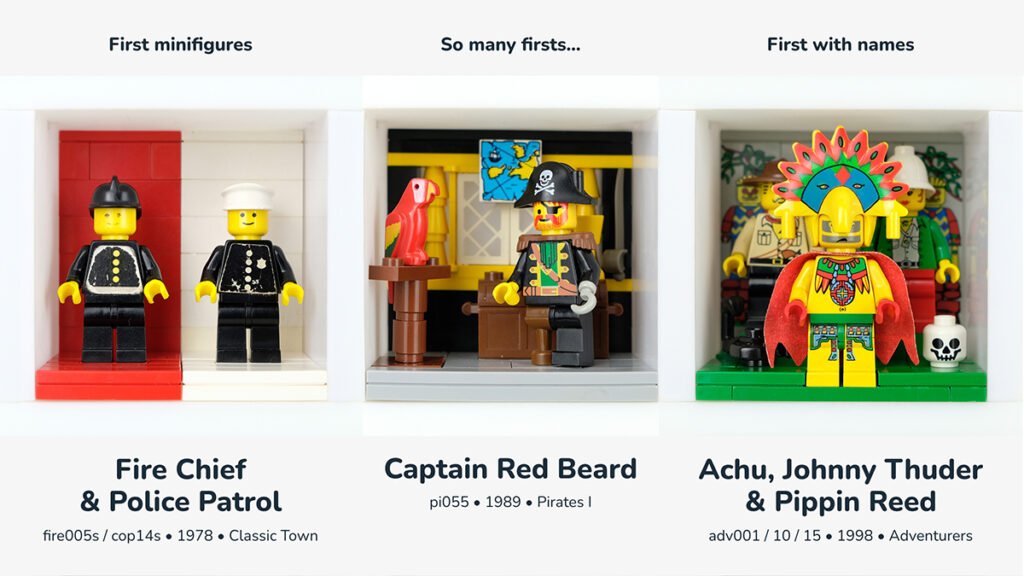
With a single 6×8 plate as a base, a collector can build a diorama or habitat directly into each space – a scene, a room, a landscape, and an homage to their favourite minifigures.
The 6×8 space is also six studs deep – deep enough to build walls with clip elements along the back, from which you can hang flags, swords, shovels, shields, radios, and any number of minifigure accessories. The back wall becomes a display surface in its own right.
The Bridging Moment
The most significant single realisation in the design process came not at a desk, but during play.
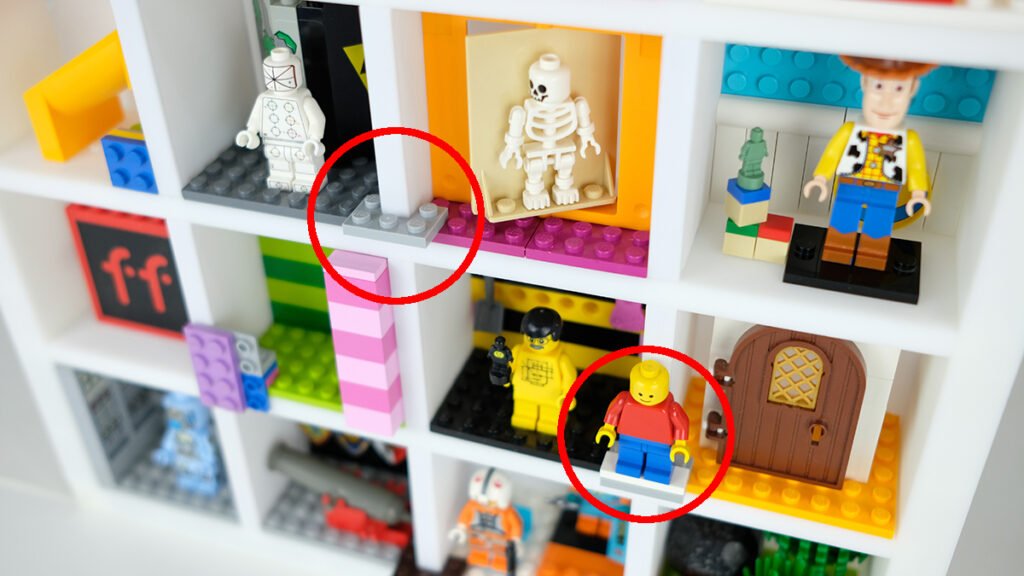
Early prototypes had thinner internal slats and slightly thinner frame edges. They looked right. The grid worked. The CMF plates fitted. But when building proud of one space – constructing a scene that extended beyond the boundary of a single aperture – the connection to the adjacent space did not align.
It was one of those moments where the problem is obvious the instant you see it, and then you cannot understand why you didn’t see it before. The slats and edges needed to conform precisely to LEGO brick dimensions – not approximately, but exactly – for the system to work at any scale.
| The bridging rule • Each internal slat: exactly one brick wide. • Each frame edge: exactly two bricks wide. This means a build that extends proud of one aperture connects seamlessly into the next – within the same frame, or across two frames placed side by side. Because the vertical measurements are identical to the horizontal, the same logic applies in every direction: left to right, right to left, up and down. Finity Frames is not just compatible with the LEGO System of Play. It is part of it. |
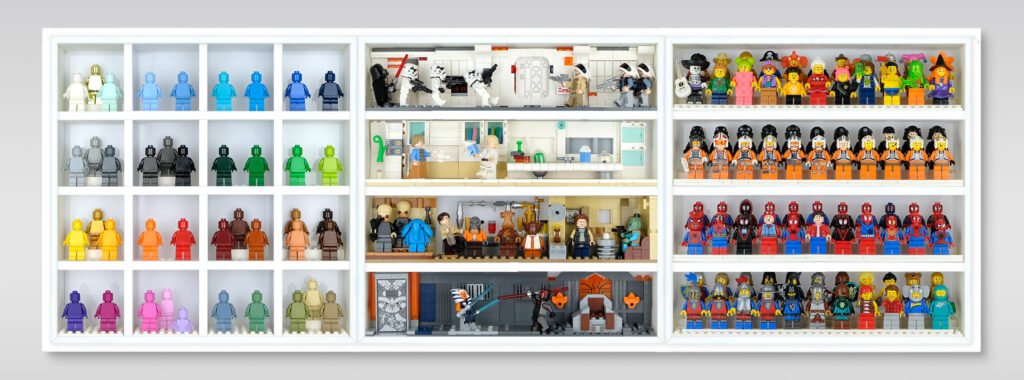
This is what the ‘display, your way’ and ‘play, your way’ language is built on. Take the covers off connected Finity Frames and you have a wall-hung building surface spanning hundreds of studs. Build a fort. Build a cityscape. Build upside-down. Build to play.
The Flexibility of Slats – 64 Configurations
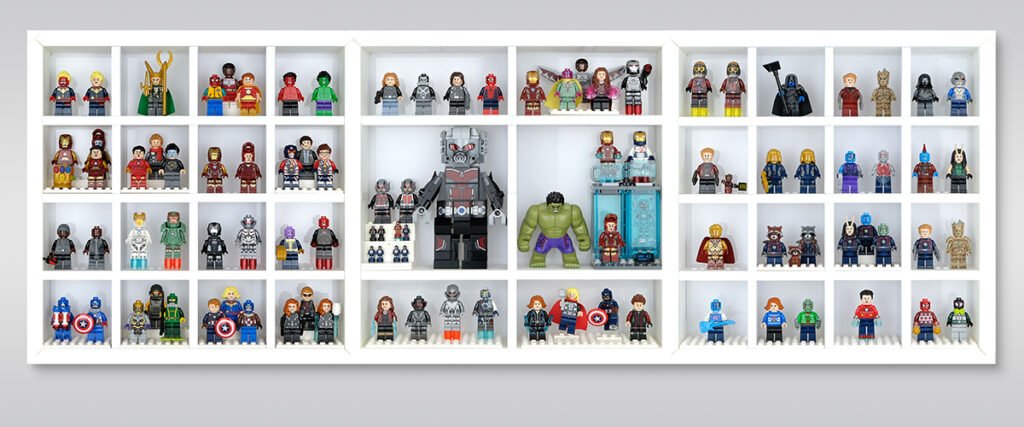
The standard 1×1 frame uses three horizontal and three vertical internal slats to create the 4×4 grid. But those slats are removable – and their removal opens up sixty-four distinct internal configurations, each one a different way of dividing the same space.
Remove some slats and individual spaces merge into larger ones – a 1×2 aperture, a 2×4, a single open space spanning the full width of the frame. Each configuration changes what can be displayed and how. A large diorama. An oversized figure. A custom build that would never fit within a standard 1×1 space.
We recommend keeping at least one horizontal and one vertical slat for structural reasons. But even a fully stripped-back configuration – all vertical slats removed, horizontal slats only – produces something precise: each horizontal slat measures exactly 35 studs wide. Not approximately. Exactly. The LEGO System of Play remains true, and with jumper plates a full width fits 88 minifigures!
The Infill Panel – The Last Piece of the Puzzle
Every good system has a problem that only becomes visible once everything else is in place. For Finity Frames, that problem was the gaps.
When slats are removed to create a custom configuration, the channels they previously occupied – the slots in the frame structure where slats sit and interlock – remain visible. Structurally, this is fine. Aesthetically, it is not. An open channel in a gallery-quality display frame is a distraction. It signals incompleteness in a product whose entire purpose is to feel complete.
The infill panel solves this. Designed to slot precisely into any unused channel, it fills the gap left by a removed slat – flush with the frame surface, invisible at normal viewing distance, and compatible with any internal configuration. Whether you use all six slats, none of them, or anything in between, the frame presents a clean, uninterrupted face.
It was the last component designed – and in some ways the most satisfying. It meant the system was truly complete. Every configuration, at every scale, in every arrangement, looks exactly as it should.
| The LEGO System of Play. Every dimension in Finity Frames – every aperture, every slat, every frame edge – is derived from LEGO brick mathematics. The 6×8 space. The one-brick slat. The two-brick edge. The 35-stud width of a fully open frame. None of it is approximate. All of it is intentional. Finity Frames was designed to display minifigures. But it was also designed to be built in. |