

On the silent damage that sunlight does to a collection – and how to stop it.
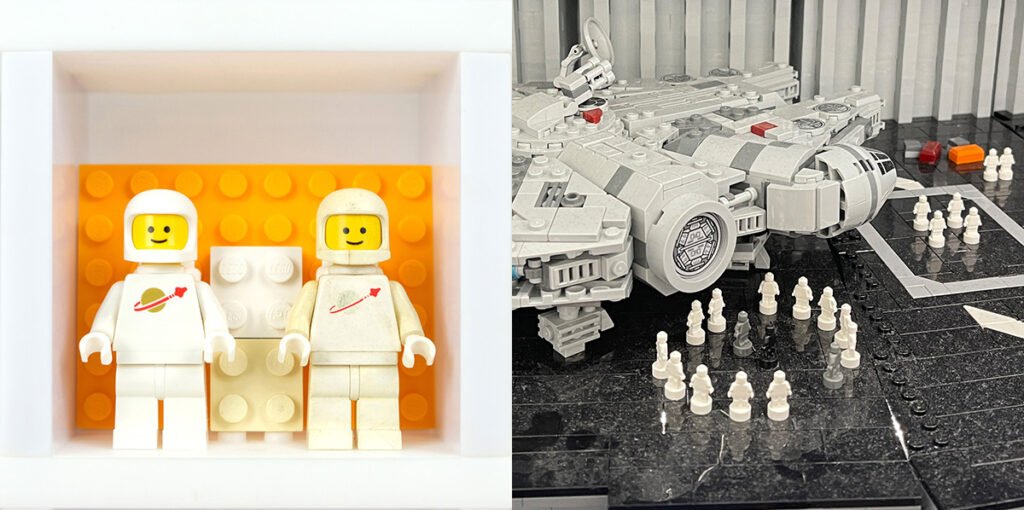
Pull an old minifigure from a box and hold it next to one still in its packaging. If either has spent time on a sunny shelf, you will see the difference immediately. A creeping yellow. A faded torso print. A white that is no longer quite white. This is not age. It is damage – and it was preventable.
Ultraviolet light causes photodegradation – a process by which UV radiation breaks down the chemical structure of materials over time. For LEGO minifigures, the results are yellowing, colour fading, brittle plastic, and the slow erosion of printed detail. The damage is cumulative, largely invisible until it isn’t, and almost entirely irreversible.
UV protection was not an afterthought in the design of Finity Frames. It was a founding requirement.
Why Australia Takes UV Seriously
Finity Frames was invented in Australia – which is relevant, because Australia is one of the most UV-intense environments on earth. Lower cloud cover, proximity to the equator, and reduced ozone shielding combine to produce a UV index that regularly exceeds anything experienced in Europe or North America.
The global UV index peaks at 11, which the World Health Organisation classifies as ‘extreme’, and Spinal Tap would approve. In parts of Australia, the index regularly reaches 15.
This environmental reality has made Australian industry notably sophisticated about UV-resistant materials. Walk past any bus stop in Sydney or Melbourne and you will see advertising behind clear acrylic panels – outdoors, in full sun, year-round – because the materials can handle it. The same engineering principles that protect bus shelter advertising protect the Finity Frames collection.
Display, Your Way
For pure display, each of the sixteen spaces in a 1×1 Finity Frame accommodates a single 6×8 plate – part number 3036 – or four 3×4 CMF minifigure stand plates, part number 17836. One, two, three, or four figures per space, arranged as the collector chooses.
The removable magnetic cover protects from dust and UV, but lifts away in a moment when the collection needs updating – a figure sold, a new acquisition added, a theme rearranged. The display is never static unless you want it to be. It evolves with the collection.
Display, Your Way means exactly that. Neat rows of single figures. Grouped by theme, by era, by colour, or by story. Full dioramas in every space. Or any combination of all of the above. The frame is the structure. The arrangement is yours.
What UV Light Actually Does to Your Collection
The mechanisms of UV damage are worth understanding, because they explain why the standard advice – ‘keep out of direct sunlight’ – is insufficient on its own.
Destruction of investment value. For rare, discontinued, or vintage minifigures – some of which trade at hundreds of dollars each – UV damage is a direct financial loss. Condition is everything in the collector market. A yellowed figure commands significantly less than a pristine one, and the decline in value can far exceed the cost of proper protection.
Yellowing and discolouration. The most visible form of UV damage in LEGO is sun-yellowing – a process driven by bromine, a flame retardant present in ABS plastic. When bromine compounds are exposed to UV light and oxygen over time, they oxidise and produce visible yellowing. White becomes cream, then tan. Blues and reds lose their saturation. The process is gradual and then, suddenly, very obvious.
Structural degradation. Beyond colour, UV radiation breaks down the polymer chains in ABS plastic at a molecular level. Over prolonged exposure, this reduces flexibility and tensile strength – the plastic becomes brittle, more prone to cracking under handling pressure, and less able to grip other pieces cleanly. For minifigures that are handled, repositioned, and enjoyed, this matters.
Fading of pad-printed detail. The pad-printed faces, torsos, and accessories that define a minifigure’s character are applied in thin layers of ink over the plastic surface. These inks are particularly vulnerable to UV exposure – facial expressions fade, torso details lose contrast, and the precise graphic work that makes each figure distinct gradually softens into illegibility.
Sticker and decal damage. Applied stickers are even more susceptible than pad printing. The adhesive layer yellows, the ink fades, and edges lift as the underlying material expands and contracts with temperature changes driven by sun exposure. A stickered piece in direct light can show visible degradation within months.
Indirect and ambient UV. A common misconception is that UV damage only occurs in direct sunlight. In practice, UV light penetrates glass, reflects off surfaces, and disperses throughout a lit room. A collection displayed near a window, even a north-facing one, accumulates UV exposure throughout the day. Over years, the damage is indistinguishable from direct sun exposure.
How Finity Frames Approaches UV Protection
Finity Frames approaches UV protection at two levels: the cover and the frame itself.
The removable magnetic cover is made from UV-stable clear Perspex® Acrylic – a material engineered with built-in UV absorbers that block nearly all harmful UV light up to 360nm. This is the standard cover included with every Finity Frame, and it offers excellent protection for the overwhelming majority of collections and display environments.
The frame itself is moulded from ABS plastic with UV protectants baked into the material – protecting the structural components of the display against the same degradation it is designed to prevent in the collection it houses.
| Standard Cover | Gallery-Grade Upgrade |
| UV-stable Perspex® Acrylic | Conservation-grade Perspex® Acrylic |
| Blocks ~99% of UV up to 360nm | Blocks 99.99% of UV up to 400nm |
| Suitable for most home, office, and display environments. Built for outdoor use in Australia. | Museum and gallery standard. |
| Included with every Finity Frame | Available as an optional upgrade |
A Note on Patina – and the Limits of Protection
UV damage is not theoretical. It is visible, and it accumulates across years and decades in ways that are not always noticed until they are compared against something that was protected.
I’ll admit to mixed feelings on this. I still have those 1979 Galaxy Explorer minifigures – the print rubbed off through play, a helmet cracked, the white darkened to cream over time. And I find the patina of those figures just as enjoyable as a pristine one. They carry a history that a mint-condition figure does not.
The goal of UV protection is not to make collections immortal or to erase the evidence of enjoyment. It is to give collectors a choice. Finity Frames protects against damage that happens without your consent – the slow, invisible work of ambient light. What you do with your collection after that is entirely your own.
Even the finest UV protection will not stop time entirely. ABS plastic will eventually degrade under any conditions. But the difference between a collection displayed without protection and one displayed behind UV-stable Perspex® is the difference between degradation measured in months and degradation measured in decades. For a collection you have spent years building, that is not a small distinction.
| Protect what you’ve built Every Finity Frame ships with UV-stable Perspex® Acrylic as standard. The frame itself is also UV-treated – so it will last decades. For collectors with rare figures, light-filled rooms, or simply an abundance of caution, the gallery-grade conservation upgrade is available at checkout – the same material used to protect exhibits in museums and galleries. Because a collection worth building is a collection worth protecting. |