

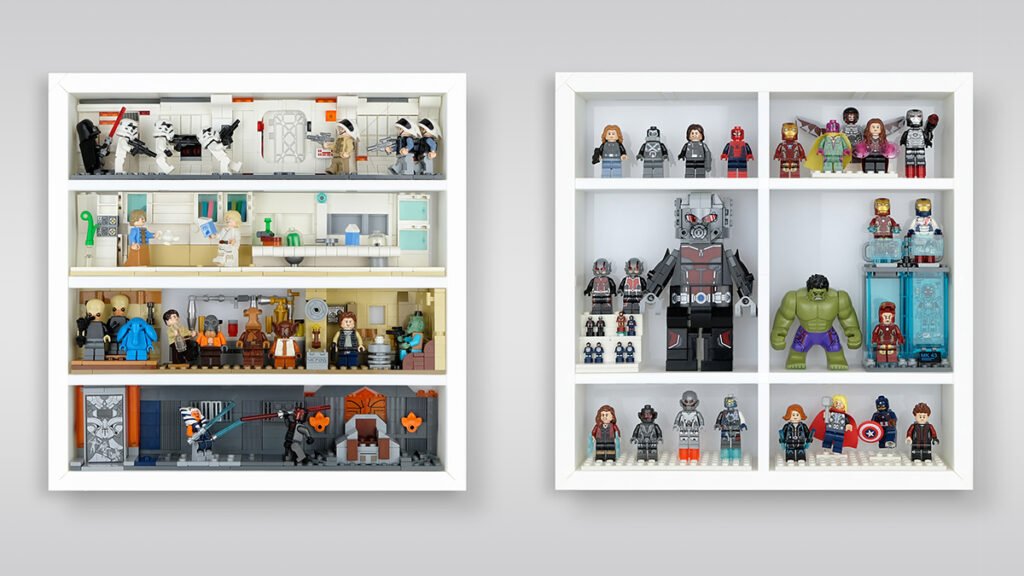
Why Finity Frames is not just a display system – and why that was always the point.
There is a question that every serious collector eventually faces, usually when a child is involved: is this for looking at, or for playing with?
For LEGO minifigures, the question has always had a third answer. They were designed for both – and the best display system for them should be too.
The Original Vision
When Jens Nygaard Knudsen’s articulated minifigure design was released in 1978 – after more than fifty prototypes – the core idea was not display. It was immersion. The minifigure was designed to give children a vehicle for storytelling: a character scaled precisely to fit within the LEGO System of Play, capable of sitting in a vehicle, standing in a doorway, manning a castle turret, or piloting a spaceship. The figure was the player’s proxy. Play was the point.
Collecting came later – as the minifigure became more detailed, more specific, more characterful, and more numerous. But the collecting impulse never replaced the play impulse. For most collectors, the two coexist. The figures are treasured objects and playable characters simultaneously. A display system that only accommodates one of those truths is, by definition, incomplete.
Finity Frames was built around both.
Display, Your Way
For pure display, each of the sixteen spaces in a 1×1 Finity Frame accommodates a single 6×8 plate – part number 3036 – or four 3×4 CMF minifigure stand plates, part number 17836. One, two, three, or four figures per space, arranged as the collector chooses.
The removable magnetic cover protects from dust and UV, but lifts away in a moment when the collection needs updating – a figure sold, a new acquisition added, a theme rearranged. The display is never static unless you want it to be. It evolves with the collection.
Display, Your Way means exactly that. Neat rows of single figures. Grouped by theme, by era, by colour, or by story. Full dioramas in every space. Or any combination of all of the above. The frame is the structure. The arrangement is yours.
Play, Your Way
Remove the cover and the frame transforms.
The sixteen spaces are no longer a display grid. They are sixteen open stages. And the frame itself – its slats, its edges, its precise LEGO-compatible dimensions – becomes a building surface.
Because each internal slat is exactly one brick wide, and each outer frame edge is exactly two bricks wide, a build that extends proud of one space – past the boundary of its aperture – connects precisely with the adjacent space. This is bridging: building across the boundaries of the frame, creating scenes and stories that span multiple spaces and, when frames are connected, multiple frames.
Imagine a 2×2 frame hung at a child’s eye level. Four spaces, two frames wide, two frames tall. In the top left, a faction of knights and dragons builds across the boundary into the top right frame, where they trade for interstellar minerals at the space port. From below, fiendish pirates spill out across the bottom row, charging into the construction site that sprawls across the join. Every space is a scene. Every boundary is a bridge.
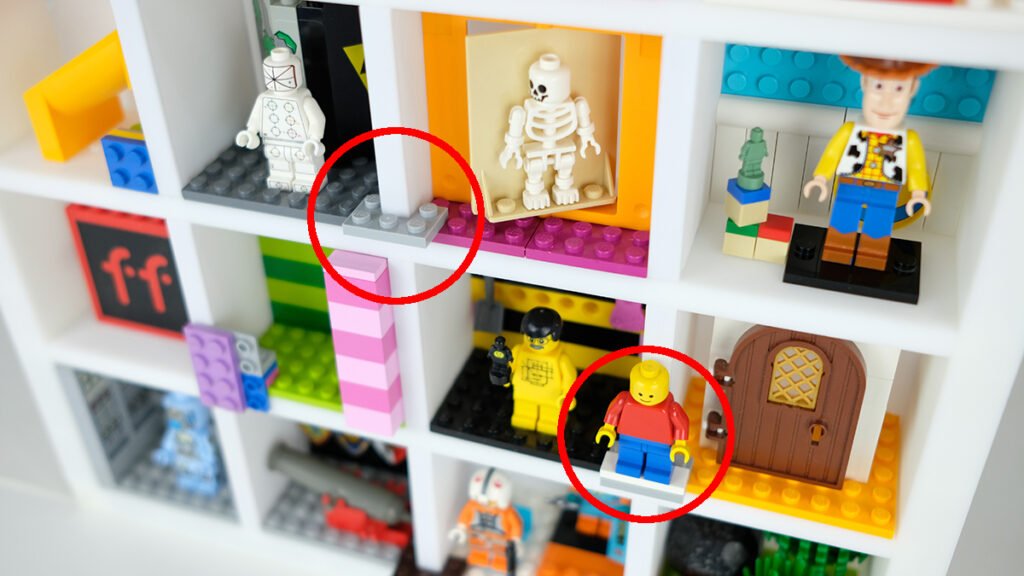
| Why ‘bridging’? The word was chosen deliberately. A bridge connects two spaces across a gap – which is precisely what a build does when it spans from one aperture to the next. But ‘bridge’ also carries the flavour of Classic Castle: drawbridges, moats, battlements. Jens Nygaard Knudsen designed Classic Castle alongside Space as part of the foundational LEGO themes and the word ‘bridging’ quietly honours that heritage. |
What Bridging Makes Possible?
Or imagine a 1×6 frame spread horizontally at play height – a single long canvas where adventure changes from left to right. Sandy deserts merge into rocky mountains. Rocky mountains give way to colourful fish-filled oceans. Western forts spill into cities that spill into the next frame, and the next. Anything you can imagine can be built within the spaces, and built outward beyond them. The frame is the map. The story is unlimited.
Because the vertical and horizontal dimensions are identical – LEGO maths applies in every direction – bridging works up and down as well as left and right. A build can rise through multiple spaces in the same frame. It can descend. It can turn corners. The wall-mounted frame becomes a three-dimensional building surface that happens to look like a gallery piece when the cover goes back on.
| For the parent who’s also a collector The cover goes on: a gallery-quality display that looks deliberate and considered on the wall. The cover comes off: an open play surface that connects with every LEGO brick your child already owns. Finity Frames resolves the tension between protecting a collection and sharing it – because the same object does both, depending on whether the cover is on. Jens Nygaard Knudsen designed the minifigure so children could immerse themselves in play. Finity Frames was designed so they never have to choose between the play and the display. |