

On blind bags, the freedom of an open brief, and the cultural shift that gave collectors permission to collect.
There are moments in the history of the LEGO minifigure that function as genuine turning points – not incremental improvements, but shifts in what the minifigure was understood to be. The first fully articulated, pad-printed figure in 1978. The introduction of realistic skin tones in the early 2000s. But arguably the greatest of all was a foil bag, a mystery, and a series of sixteen characters released on no particular theme in 2010.
LEGO Collectible Minifigures – CMFs – changed not just what LEGO made, but what it meant to collect them.
The Minifigure as Storyteller
The minifigure was designed by Jens Nygård Knudsen (for whom the Finity Frames pad-printed minifigure is named in honour of) and co-patented after more than fifty prototypes. The driving idea was to give children a vehicle for immersive storytelling – a figure with enough articulation to become a character, scaled precisely to fit within the broader LEGO System of Play.
From the outset, the minifigure evolved through its details. The first printed faces arrived with the first articulated figures in 1978. Captain Redbeard brought a wooden leg, a hooked hand, and a dual-printed face in 1989 – a figure with a story built into its anatomy. Jar Jar Bink’s custom head mould arrived in 1999. Realistic skin tones followed in the 2000s. Each innovation was a step toward a more specific, more characterful, more collectible object.
LEGO had always understood that the minifigure was the point. What changed in 2010 was the decision to make that understanding explicit.
Before CMFs – The Lineage of the Collectible Figure
The instinct to sell minifigures for their own sake – rather than as components of a larger set – did not begin with CMFs. It began, quietly, a decade earlier.
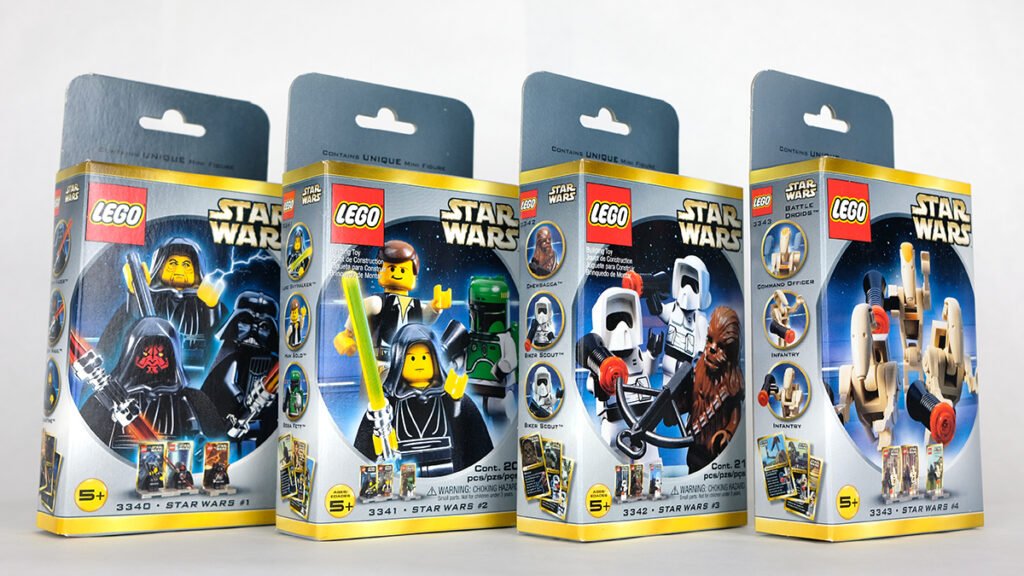
In 2000, one year after the launch of LEGO Star Wars, LEGO released four minifigure packs built around the new licence – sets 3340 (Sith), 3341 (Han, Luke, Boba Fett), 3342 (Chewbacca and Troopers), and 3343 (Battle Droids). Each pack contained three characters, a stand, and a collectible card. The logic was clear: the major LEGO Star Wars sets were birthday and Christmas territory. The minifigure packs were for pocket money.
The same year, LEGO released the Mini Heroes Collection – using the same footprint – with Town, Ninja, and Rock Raiders packs. Minifigures on stands with a backstory card. Not in a set.
These were tentative steps. They were theme-dependent, and limited. But they pointed toward something. LEGO was testing whether collectors would buy the minifigures without the set. The answer, it turned out, was an emphatic yes.
A Saturday in Beatties
I should say something about where this love of collecting came from, because it matters to understanding why CMFs landed the way they did.
There was a toy shop in Lewisham called Beatties. Its glass windows held an intoxicating line-up of everything that made the early 1980s the golden age of the toy. You might want to sit down for this.
| Beatties, Lewisham (London, UK), in the late 80s • Kenner Star Wars – hanging rows of fresh Return of the Jedi and Power of the Force figures. • Scalextric – high-speed banking, figure-of-eights, racing Mini Coopers, Magnatraction, and the first 360˚ spin-around chassis. • Airfix – 1:72 scale Hawker Hurricane Mk.1s, Afrika Korps troops, everything. • Transformers, He-Man, Action Man in his myriad outfits and vehicles. • The first Tamiya remote-control off-roaders that set the tone for the remote control world – the Grasshopper, Super Shot and Frog. • Rows upon rows of yellow-edged LEGO sets. Box art as good as what was inside, plastic inners and those foldable lids. Peak. |
If a time machine existed, I would go back to any one of those dozens of Saturdays, armed with a wedge of notes, and take home as much as my arms could carry – the thick plastic bag handles cutting into my fingers.
I digress.
The point is this: even then, saving up my pocket money and the proceeds of a Saturday morning bakery job, I was drawn not to the largest sets but to the smaller ones – the sets that were mainly figures. Classic Space. Castle. Pirates with a shark and a monkey. City sets like the original 600 Police Car – a simple vehicle and a single minifigure. The figures not only enriched the stories I could tell with the sets I already owned. They gave me the pleasure of completing something.
That itch – the pleasure of the complete set – was already there before CMFs gave it a name.
The Open Brief – What CMFs Actually Did
What made CMFs different from the Star Wars packs and the Mini Heroes Collection was not the format. It was the freedom.
Every previous attempt at a standalone minifigure product had been tethered to an existing theme – a licence, a property, an established visual world. CMFs cut those ties entirely. The design team was handed an open brief: design anything. No existing universe to reference. No licence to honour. Just the minifigure as a canvas.
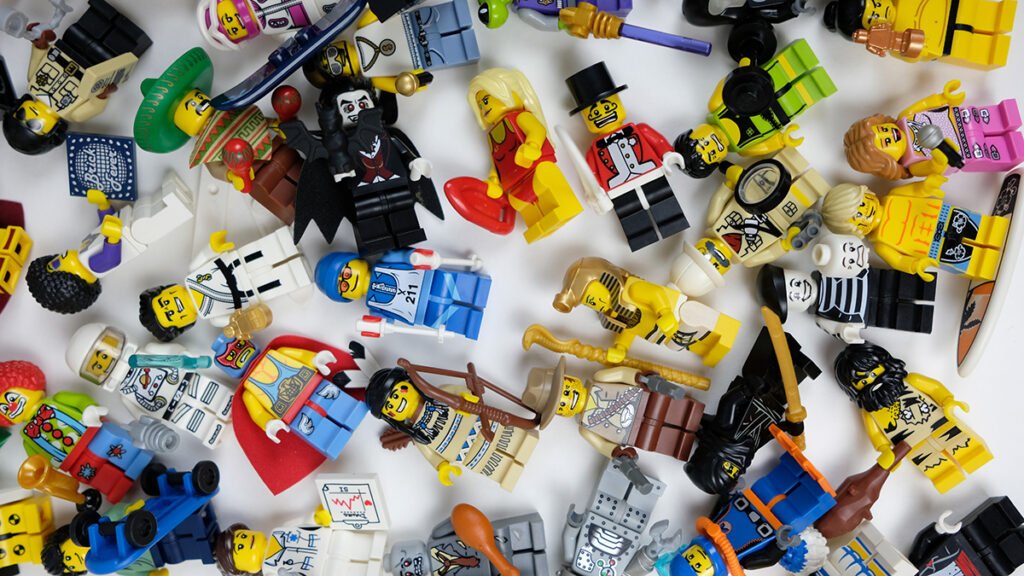
An open brief is often the hardest kind. Without constraints, the creative possibilities are infinite and therefore paralysing. LEGO’s design team met that challenge with extraordinary discipline and playfulness simultaneously. Series 1 and 2, released in 2010 a few months apart, introduced thirty-two figures that tore up the themes rulebook: a cheerleader, a ninja, a spaceman, a zombie, a mime artist, a tribal hunter. Not a single one belonged to an existing LEGO world. All of them were immediately, recognisably LEGO.
CMFs also gave LEGO’s designers the freedom to push the minifigure itself. New head moulds. New hair pieces. New accessories, hands, legs, and printing techniques that had never been used before – because no existing theme had ever needed them. The open brief did not just produce thirty-two new characters. It produced innovations that filtered through into the broader LEGO catalogue for years.
The Foil Bag and the Feel
None of this would have landed the way it did without the blind bag.
CMFs were sold in sealed foil bags. You could not see what was inside. You could not choose your figure. You could only feel – pressing and prodding the bag for the distinctive shape of a pom-pom, a shield, a banana, a club – and infer. The experience almost always came with standing next to another collector in the toy aisle, both of you silently feeling bags and mentally ticking off lists. It turned buying into a ritual.
For collectors, the opacity only added to the appeal. The satisfaction of completing a full series through feeling, trading, and hunting was a different pleasure from simply buying a set, and the early years of an adult meeting another adult in a toy or hobby shop and sharing that experience was a little awkward but actually refreshingly social.
The Jumping-Off Point
CMFs gave me an avenue to jump fully back into collecting minifigures. Save for a $5 FEGO (that’s fake LEGO) Mr Gold – a figure so rare and coveted that counterfeit versions exist – I have collected every CMF series since Series 1. That is every figure, from every series, in the fifteen years since the format launched.
But CMFs did something else for me that I only understood in retrospect. They gave me the itch I couldn’t quite scratch: what do you do with them once you have them all?
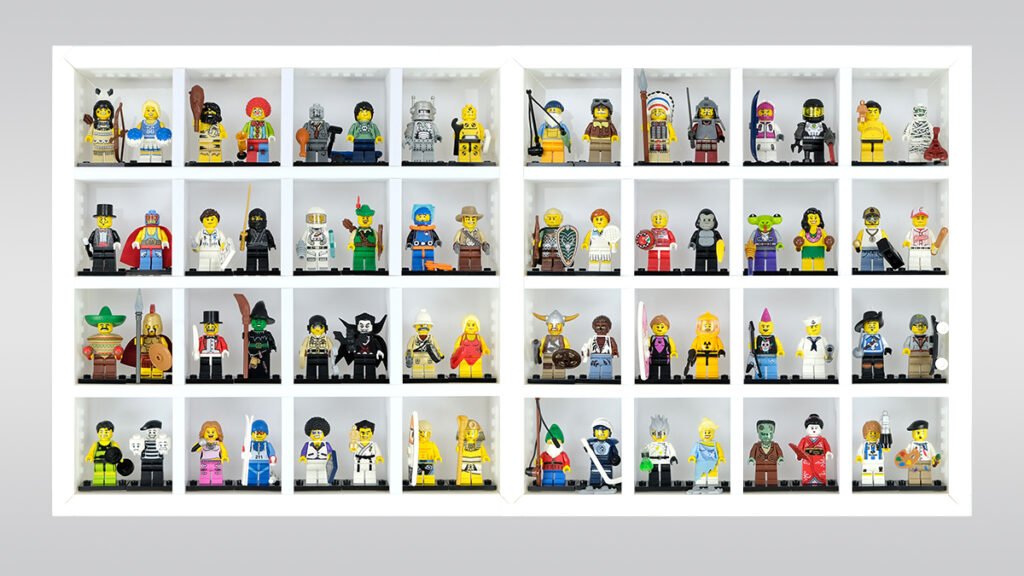
I remember sitting in the café at LEGOLAND Windsor and seeing how the CMFs had been displayed on the wall. Individual white-bordered frames, each one housing a complete series, the background colour matching the blind bag of that release. You could see the whole series at once, and somehow the figures looked different – more intentional, more serious – when they were displayed rather than stored.
And then there was the hotel reception. Hundreds of minifigures – perhaps thousands – arranged in neat rows, spanning several metres across the reception space. A wall of figures that read, from a distance, as a single unified work. Not toys. Art. The same wall that appears, recreated, in LEGO Masters.
Both images stayed in my subconscious for years. They were part of the visual thinking behind Finity Frames – the idea that a minifigure collection, properly displayed, becomes something greater than its individual parts.
Key moments in the minifigure timeline
1978 First fully articulated, pad-printed minifigures released. Jens Nygaard Knudsen’s design after 50+ prototypes.
1989 Captain Red Beard (Captain Roger) – peg leg, hook hand, dual-printed face. The minifigure as character.
1999 LEGO Star Wars launches. Yoda’s custom head mould and short legs. The licenced figure arrives.
2000 Star Wars minifigure packs and Mini Heroes Collection. The first standalone figure products.
Early 2000s Realistic skin tones introduced. The minifigure becomes more human.
2010 CMF Series 1 and 2 launch. The open brief, the blind bag, and the cultural shift that followed.
| CMFs didn’t just change collecting culture. They changed what collectors thought was possible. By giving the minifigure its own stage – untethered from themes, free from licence constraints, complete in sixteen – LEGO acknowledged what collectors had always known: that the figure itself was the point. Finity Frames was built on the same belief. Every series has a home. Every figure deserves to be seen. |