

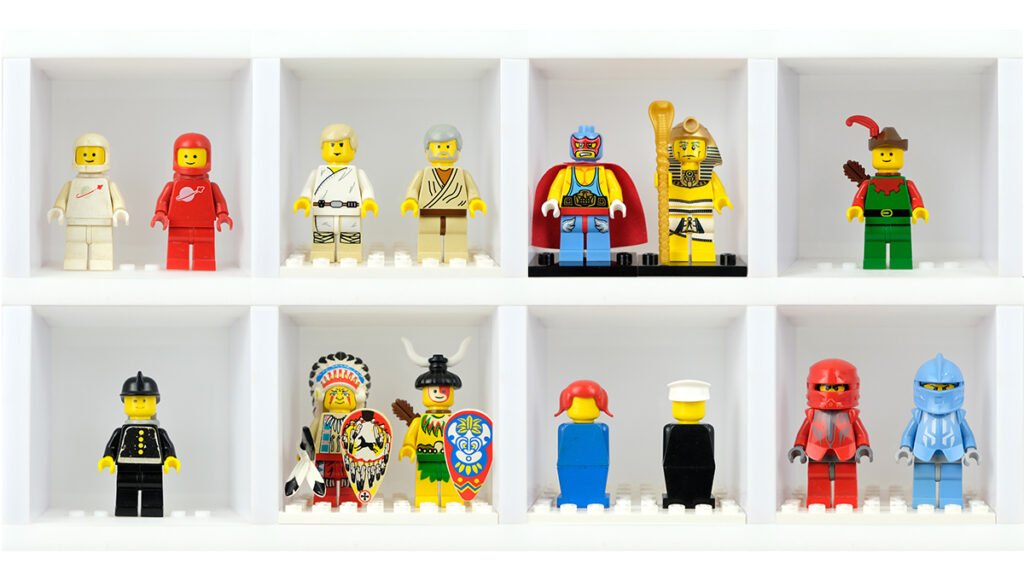
From brick-built maxifigures to pirates, astronauts, and the birth of Star Wars – a year-by-year account of the first three decades of minifigure innovations.
1978 was the birth of the articulated minifigure – so the header isn’t rage bait.
But to understand the significance of 1978, we should start even earlier. The first brick-built figures appeared in 1963 with the Doll Sets (set 1905), created under Samsonite and released as a Sears exclusive in the US. A canister of 266 elements that could be assembled into a number of figures demonstrated, even then, that people belonged in LEGO’s world.
What follows is a year-by-year account from 1974 – when LEGO Designer, Jens Nygård Knudsen, began the design work that would lead to the articulated minifigure – through to 2004: thirty years of innovation, experimentation, and an ever-expanding cast of characters that now numbers in the thousands.
Annual figure counts in this article include all styles released that year – including non-standard figures such as DUPLO, Fabuland, Technic, and Scala. A note on counting methodology appears at the end of this article. Last updated: September 2.
1974
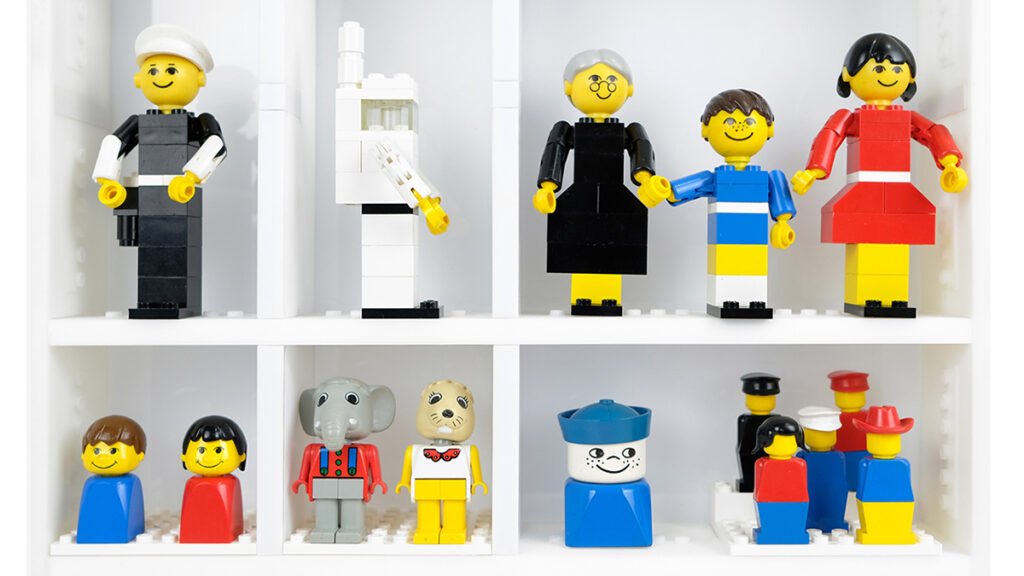
LEGO introduce buildable figures – eight bricks high – known as LEGO Building Figures, or maxifigures as they appear on BrickLink. Constructed mainly from 2×2 bricks, they have rounded yellow printed heads, interchangeable hair and hats, and moveable arms. Set 200 – Family – is the epitome of this move to character integration, as it contains only figures.
This is the year we welcome that classic yellow LEGO skin tone. LEGO chose the colour to be neutral to any specific real-world peoples, so children could project themselves into the characters.
1975
1975’s Moon Landing set (367) uses transparent 2×2 bricks as astronaut helmets on maxigures.
The first LEGOLAND three-part minifigures appear, with fixed arms and legs, unpainted faces, and two hat types (stetson and cap) and one hair type (pigtails). Fire, Police, and Hospital sets are released with these new stiff-armed storytellers, including a Wild West Scene (set 365) that features eight minifigures. First stickered torsos – a Red Cross on old046 and old047.
| 27 new minifigures released |
1976
LEGO continue innovating, releasing the first maxifigure set (1075) with enough elements for eight figures. LEGO also introduces DUPLO – figures with a squat 2×2 DUPLO brick base, equivalent to a 4×4 LEGO brick base.
| 26 new figures released (inc 9 DUPLO) |
1977
The first Shell collaboration launches. Santa Claus makes his first appearance as a brick-built figure in set 246.
| 10 new figures released (inc 4 DUPLO) |
1978
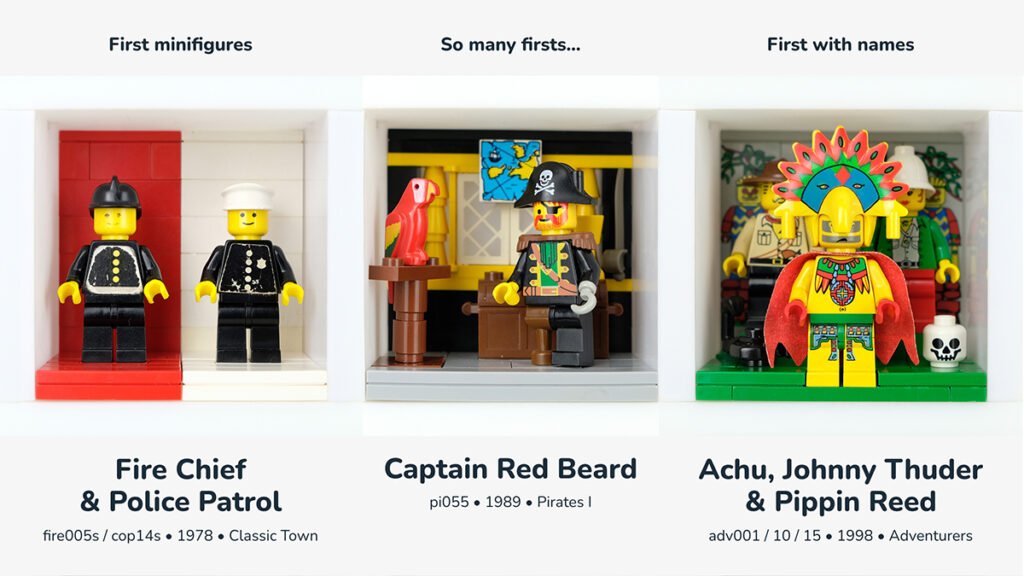
The first articulated minifigures arrive. Of the first series, all have sticker to apply to the torsos, or – for Castle – stickers to apply to a vest. Themes launched include Classic Town (Police, Hospital, Fire, Traffic, Coast Guard, Construction, and Gas Station with Shell), and Classic Castle. Castle brought in the first ever minifigure weapons; a halberd (axe), lance and shortsword, and while you think of mounted knights on horse, those first horses in the iconic yellow castle (set 375) were made of bricks. LEGO horses were not introduced until 1984.
New headpieces include two hard hat styles for construction and fire, new helmets for motorcycle and Classic Castle, and the first air tanks (fire019), which went on to be used the following year for Classic Space.
Of particular note is the Nursery set (297), unique in featuring both maxifigures AND a minifigure (pln112) – where the minifigure takes on the role of a play doll for the larger figures.
| 66 new figures released (inc 1 DUPLO) |
1979
First printed torsos. Classic Space launches with both plain torsos for stickers and printed torsos. The chef’s hat is introduced, along with a new male hairpiece (cas077). First minifigures with different colour torsos and arms (cas230 & cas079).
Fabuland makes its debut with 16 new figures, each animal-headed and five bricks high. Helmet visors introduced for knights.
| 59 new figures released (inc 8 DUPLO and 16 Fabuland) |
1980
Bill and Mary (bb0001 & bb0002) become the first two named minifigures, with Bill also known as Billy. They came about from LEGO’s marketing department who wanted to teach children how to tell stories with the newly invented minifigure. The catalyst was the 84-page, hardcover 1980 LEGOLAND Idea Book. Inside, the book followed not instructions, but two characters – Bill (after Billund) and Mary – though in the UK edition in the Bricks ‘n’ Pieces LEGO Club magazine they took on the names of Captain Indigo and Polka Dot. Of course. Well, at least those two names proved you could create any story from the same pieces.
On Bricklink you can see Bill and Mary listed with their respective codes, but next the legend ‘Item appears in’ it says N/A – they don’t appear in any set. This is why. The book came with a custom sticker sheet, and to create either character children would find plain torsos from their own collection, and place these stickers onto them. In the books they had white torsos, but really in the spirit of the playing ethos, Bill and Mary are technically correct in every colour combination available until 1980, making them also the first custom minifigures.
The top hat debuts on an all-black statue (old045). An Exxon collaboration produces three minifigures with printed torsos.
| 58 new figures released (inc 8 DUPLO and 5 Fabuland) |
1981
First finger puppets (4224c01 / 4224c02). Soccer introduced under the Sports theme.
| 29 new figures released (inc 2 Basic finger puppets, 5 DUPLO, and 7 Fabuland) |
1982
Post Office introduced in Classic Town.
| 48 new minifigures released (inc 2 DUPLO and 20 Fabuland) |
1983
The basic shape of Fabuland minifigures provides the template for later updated DUPLO figures. Set 2618 Deep Sea Diver features a charming floating red boat and a new DUPLO diver connected by a string and red reel – the first minifigure (4555pb094) to feature such an attachment.
| 26 new figures released (inc 3 DUPLO and 4 Fabuland) |
1984
The Peasant (cas092) and Blacksmith (cas089) introduce a new hood headpiece. Crusaders, Lion Knights, and Black Falcons launch, complete with decorative plumes on helmets with grilles. The quiver releases as one of the most beloved accessories in the Castle line. This theme also introduced the arrow quivver with two arrows accessory, longbow, along with the first ever horses.
DUPLO figures appear in both the original style (2×2 DUPLO base) and a new style.
In Paradisa, we get the first ever minifigure print using a gradient, Surfboard on Ocean (par031a), technically extremely hard in pad printing, which is best for single colour, crisp lines.
| 54 new figures released (inc 9 DUPLO and 8 Fabuland) |
1985
The first year LEGO releases more than 100 new minifigures. The first LEGO droids appear in Classic Space (sp075 / sp074). Airport joins the Classic Town line-up. LEGO releases the first super-sized minifigure set, ‘Community Workers’, containing 24 minifigures with 19 accessories including radios, hammers, nine red bicycles, and three motorbikes (set 1063).
| 101 new figures released (inc 10 DUPLO and 6 Fabuland) |
1986
Technic figures appear. The Castle Maiden (cas095) receives a large pointy cone hat. The first Paradisa minifigure (par013) launches with the Riding Stable (set 6379).
| 88 new figures released (inc 27 DUPLO, 10 Fabuland, and 9 Technic) |
1987
Two new space themes emerge: Blacktron I, and Futuron. Harbour extends the City line, and Forestmen grow the Castle theme deep into the forest.
| 60 new figures released (inc 1 DUPLO and 8 Fabuland) |
1988
The penultimate year for Fabuland, with four new figures: Catherine, Edward, Lionel, and Paulette. Black Knights join the growing Castle line-up.
| 71 new figures released (inc 13 DUPLO and 4 Fabuland) |
1989
Charlie / Joe Crow (fab004h) dons his red pilot’s hat and, figuratively and literally, takes Fabuland away on its last flight from the LEGO line-up.
His departure makes way for possibly the most exciting release since the minifigure’s arrival in 1978. The Pirates theme brings so many firsts – the most notable being the first classic yellow LEGO heads not printed with two eyes and a smile. For twelve years, LEGO never moved away from the original joyful face template seen on the founding patents. With Pirates, the Pandora’s box was flung open on what might be possible. Moustaches, stubble, eye patches, and sideburns emerging from under bandanas. A revolution in character expression.
Captain Red Beard (pi055) stands as the literal figurehead of the era: the first two-colour printed face, a wooden peg leg, and a hook for a hand. Both Red Beard and the accompanying Imperial Soldiers sport new bicorne and tricorne hats with printing – another first.
The Black Seas Barracuda (set 6285) also carries the first female minifigure with a printed fringe, red lipstick, necklace, and ruffled shirt, along with a 2×2 printed treasure map, two rows of cannons, and a treasure chest filled with chrome gold coins. Red Beard’s parrot and monkey sidekicks both debut too.
Also in this series we’re brought the first epaulettes, backpacks, cutlass, flintlock musket and pistol.
In 2023, LEGO release a LEGO House exclusive (meaning it can only be bought at the LEGO House store in Billund) ‘A Minifigure Tribute’, designed by Marcus Rollbühler to celebrate 45 years of the minifigure. It is an up-scaled version of Red Beard, complete with a 6×6 map taking place of the original 2×2.
The year also sees the first – and only – MD Foods minifigure (MD, Denmark’s international dairy cooperative).
| 71 new figures released (inc 25 DUPLO and the final Fabuland) |
1990
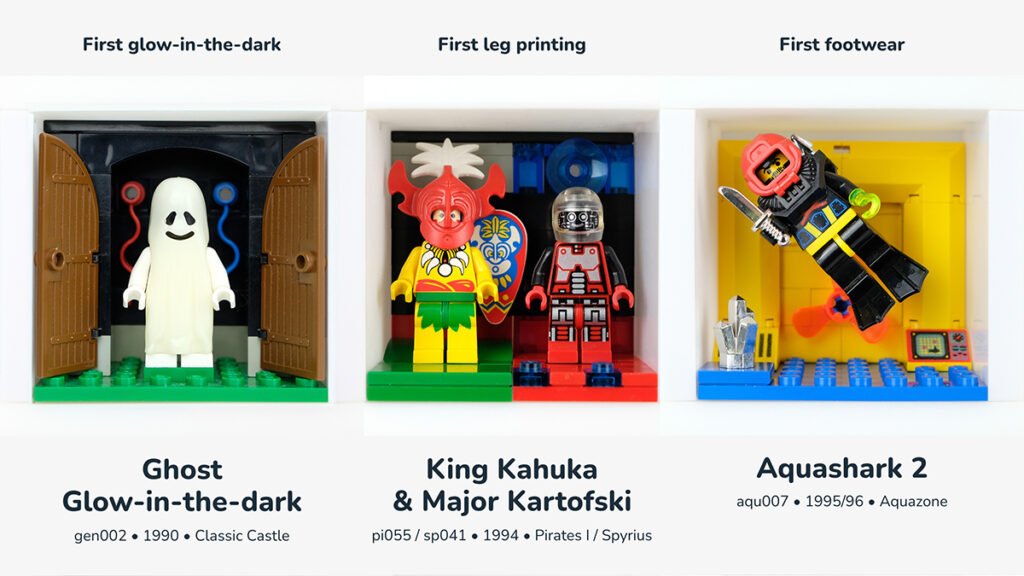
Things get spooky as the ghost enters the Castle theme – marking the first time any LEGO element glows in the dark. The ghost marks another first – the first non-human minifigure. Up until this point every minifigure had depicted a human in some role or fantasy universe. First crossbow.
Dresses appear for the first time in Castle, with the Maiden (cas097) swapping articulated legs for a blue 2×2×2 slope to match her corset torso and new head print with red lips and expressive hair.
The M-Tron theme launches. The first NASA astronaut (sp065) is released.
| 73 new figures released (inc 10 DUPLO and 1 Technic) |
1991
Blacktron II launches, comprising just three minifigures. The Train theme arrives, first in 9V configuration.
| 89 new figures released (inc 29 DUPLO, still mixing 2×2×2 and Fabuland-style) |
1992
Imperial Guards join the Pirates line-up. Octan opens its first service station in Classic Town.
| 83 new figures released (inc 12 DUPLO) |
1993
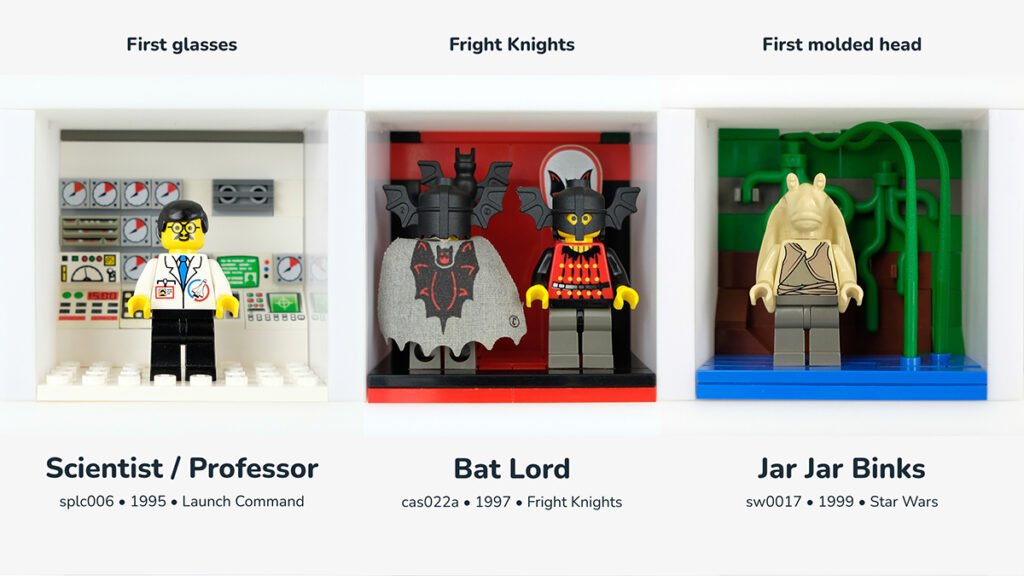
The first minifigures – Dragon Knights (cas001 / cas236 / cas209) – appear with not just a starch-stiffened woven fabric capes, but wonderfully printed capes using specialized textile screen-printing. Those same figures introduce two legs comprised of two different colours.
The legendary Majisto the Wizard releases with the first separate flowing beard piece.
First minifigures (jbr007, cop005, and cop010) with printed motorcycle helmets.
1993 introduced another technological marvel at LEGO which directly opened up new design avenues for minfigures – co-injection and dual-colour molding machines. These work by splitting the injection molding cycle, so a single colour is injected first (picture King Kahuka’s yellow legs) then a sub-gate opens within the mold in a fraction of a second and shoots a second colour (green for Kahuka’s loin cloth) into the remaining gap. Done at such speeds, the two plastics melt together perfectly, giving us what we know as ‘dual-molded legs’.
| 99 new figures released (inc 11 DUPLO and 6 Technic) |
1994
First printed minifigure legs – the Islanders range and the Spyrius Droid, Major Kartofski (sp041). LEGO BelVille™ launches. The Islanders bring epic accessories and beautiful printing, with King Kahuka (pi068) an essential collectible featuring a bold mask and colourful shield. The Race theme launches. The first black minifigure head appears on the Spyrius Droid, Major Kartofski (sp041), printed in silver.
| 151 new figures released (inc 16 BelVille and 64 DUPLO) |
1995
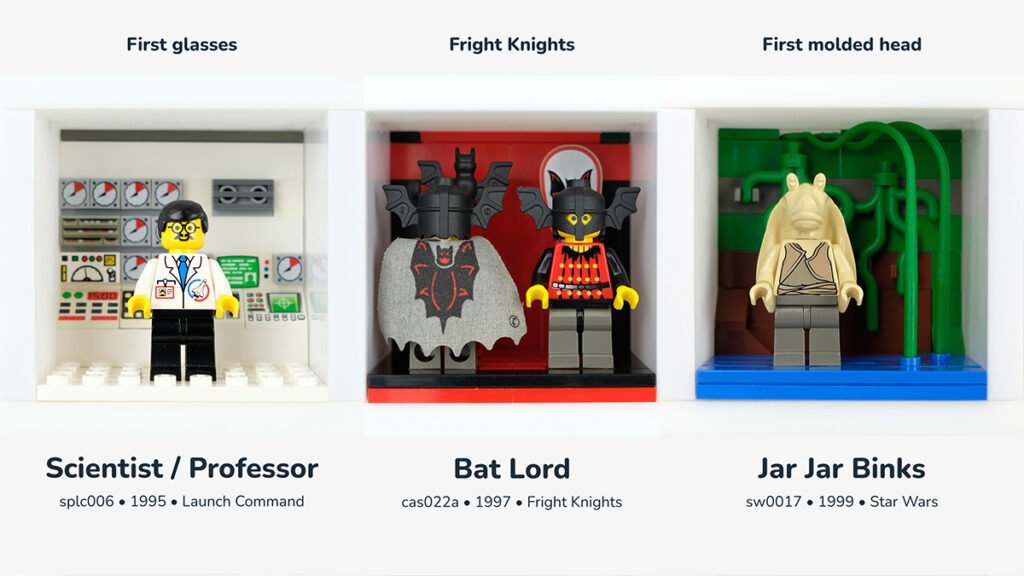
New themes: FreeStyle, Aquanauts, Aquasharks, Launch Command, and Primo all launch. First figure with glasses: the Scientist / Professor (splc006). First skeleton (gen001). First footwear with blue and black flippers for underwater divers, along with the first chrome silver pieces – diver’s knives.
One of the finest minifigures ever released – King of the Royal Knights (cas060) – arrives with a new chrome crown and Lion Knight cape. This is the first time any accessory is not made from hard plastic, and bring in yet more new machinery into the LEGO factory along with a new line of raw material supply chain for fabric.
First minifigure Santa (hol006).
Skeletons, while technically not minifigures under LEGO’s own definition, make their debut – and also mark the first time a minifigure head appears in a colour other than LEGO yellow. Most skeletons are white; one is black (Harry Potter, Goblet of Fire, 2005), one sand colour (Ninjago, 2011), and two sand green (Harry Potter Dementor, Goblet of Fire).
An amazing nugget of history for the skeleton was that it was first fully developed by designer, Niels Milan Pedersen, to be released as part of the 1989 Pirates theme. However, it was delayed by five years as LEGO executive, Godtfred Kirk Christiansen, explicitly halted production over fears that it might be too scary for children. That five years allowed for a refined design that hit sets in 1995 and – key to the redesign – were floppy arms that could not hold weapons to attack.
| 101 new figures released (inc 4 Primo, 5 BelVille, 26 DUPLO, and 5 Technic) |
1996
First translucent minifigure pieces – an Aquashark with a green hooked hand, and an Exploriens Droid with a trans-clear head (sp101a). Seemingly innocous, this was another mini-milestone as it proved that translucent polycarbonate could employ the same clutch-power tolerances of solid ABS plastic.
New LEGO themes: Dark Forest, Exploriens, Imperial Armada, Time Cruisers / Twisters, and Western.
Western becomes an instant classic, pitting blue cavalry against wild west characters with brilliant names including Flatnose Curry, Flatfoot Thompson, and Dewey Cheatum. Western also introduced the first ever pistol and rifle. Fort LEGOREDO (set 6769) earns a place on every collector’s Christmas list, even to this day.
| 149 new figures released (inc 11 BelVille, 14 DUPLO, and 5 Technic) |
1997
Following the white and black minifigure heads of previous years, the UFO theme releases a wider spectrum of coloured heads: translucent-neon orange (sp047), blue (sp043), red (sp044), and trans-neon green (sp042).
Fright Knights make their first and last appearance, including Bat Lord with cape (cas022) and the Witch with cape (cas215). Indians join the Western line-up with some of the most detailed printing seen to date – Indian Chief / Big Chief Rattlesnake (ww017) and Medicine Man (ww019) are essential collectibles.
Scala™ launches – LEGO’s answer to the Barbie doll. Games and the single-year RoboForce themes also release. First digital minifigures appear in the LEGO Island video game.
| 175 new figures released (inc 19 Scala™, 1 Primo, 19 BelVille, 10 DUPLO, and 8 Technic) |
1998
The first year LEGO releases more than 200 new figures. Hydronauts, Stingrays, Extreme Team, Insectoids, Soccer, RES-Q, Christmas, Adventurers, and Ninja themes all launch. The Ninjas are an instant hit and remain highly collectible and bring with them the first katana.
RES-Q and Extreme Team are the fitst minifigures to have dual sided torso printing.
Adventurers is the first theme where all characters are named – except the mummies. Prized figures include the lead character Johnny Thunder, alongside Maharaja Lallu (adv030), Achu (adv001), Señor Palomar (adv023), and Pharaoh Hotep – who sports the first grey minifigure head, alongside the Insectoids Zotaxian Aliens (sp020 and sp028).
| 218 new figures released (inc 19 Scala™, 1 Primo, 19 BelVille, 10 DUPLO, and 8 Technic) |
1999
LEGO Star Wars hits the shelves. Sets released to coincide with the cinematic release of Episode I bring 28 new minifigures across Star Wars, Episode I, and Episodes IV/V/VI.
LEGO’s minifigure numbering switches to four digits for this theme – perhaps anticipating the scale of what was to come.
Only one other theme started with four digit codes, rather than three: Super Heroes in 2011.
The NINJAGO line up, which was originally three-digits, increased to four in April 2025 on BrickLink and BrickSet due to its unexpected success (at time of writing there are 979 NINJAGO minifigures), so The Golden Weapons Zane njo001 became njo0001.
Jar Jar Binks (sw0017) becomes the first minifigure with a specially sculpted head. The first Star Wars droids arrive: R2-D2 (sw0028) and Battle Droid (sw0001), along with the extraordinary Gasgano (sw0043) and Sebulba (sw0980). R2-D2 is assembled from two existing LEGO elements repurposed with characteristic ingenuity: a round 2×2 dome and a 2×2×2 robot body with legs using Technic pin connections.
Amazingly, even though the starch fabric 4cm-high cape was introduced in 1993, this is the first time it was used without any printing – in black – for Darth Maul (sw0003).
Rock Raiders launches as a precursor to the later Power Miners sets, and introduces the first oversized (big fig) creature – the brown Rock Monster (30305c01) – which establishes the dimensional values for future large figures including Hulk and Thanos. FIRST LEGO League also debuts, bringing STEM challenges to children aged 5–16.
First non-minifigure head used as a minifigure element: the trans aquarium piece (3626pb0004).
| 195 new figures released (inc 3 Scala™, 7 Primo, 21 BelVille, 21 DUPLO, and 13 Technic) |
2000
Last Technic figures released, spanning 1986–2000 with 73 variations.
Star Wars continues with Aldar Beedo (sw0006) challenging 1999’s Sebulba as possibly the most extraordinary minifigure yet released. Chewbacca joins the line-up, most notably in one of four Star Wars minifigure packs, each containing three iconic characters, extended base plates with grooves, and a collectible card.
Dino Island adds briefly to the Adventurers line-up before becoming extinct the same year. Knights Kingdom I, Arctic, and Studios themes also launch. LEGO Studios, supported by Steven Spielberg (who is reported to have been actively involved beyond simply lending his name) allows people to create stop-motion animations using a LEGO camera and software. The theme proves enormously influential in the growth of LEGO stop-motion animation, helping spawn Brickfilms.com and eventually LEGO Studios.
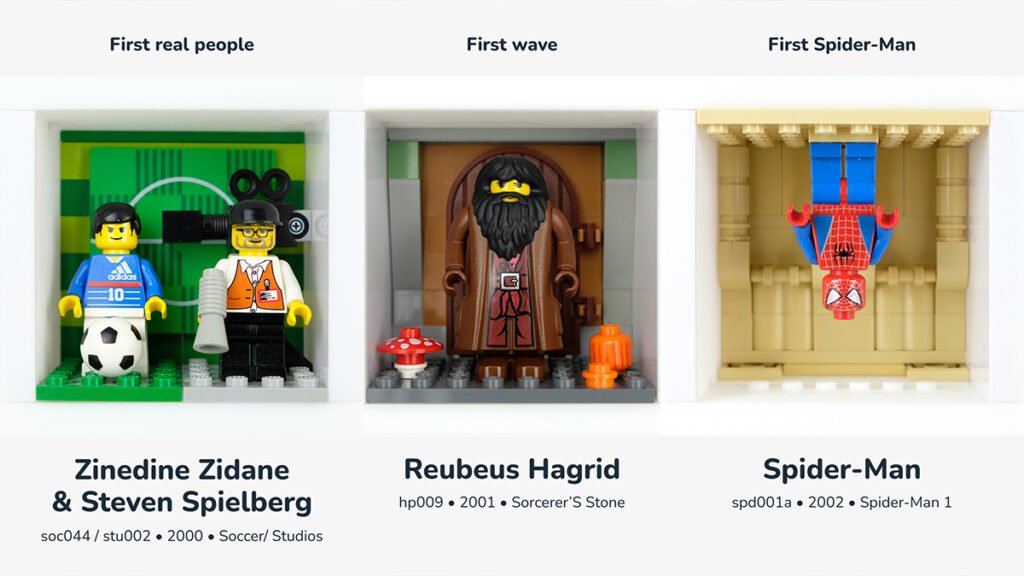
Soccer releases 89 different minifigures, including the first real people ever represented as LEGO minifigures: France’s No. 10, Zinedine Zidane (soc044), and Steven Spielberg (stu002). Both are also the first minifigures with torso printing on both front and back (outside of keychain figures). Halloween makes its formal debut under the Holiday & Event theme with a skeleton sporting a top hat (gen027).
| 264 new figures released (inc 9 Scala™, 3 Primo, 15 BelVille, 14 DUPLO, and 14 Technic) |
2001
The final Scala™ figure released: the skateboarding Marie (scaFMEY07).
Studios produces the rare Quicky the Nestlé Nesquik Bunny (gen003), with distinctly un-LEGO-like widely spaced eyes. Jack Stone launches under the 4 Juniors theme – a visual hybrid of BelVille and Technic figures. Xalax arrives as a sub-genre of Racers. Alpha Team and Life on Mars (19 minifigures in a single year) also hit shelves.
Star Wars continues with Watto (sw0038) a highlight, alongside the first ever Stormtrooper (sw0036). But the hero release of the year is Harry Potter and the Philosopher’s Stone – including Professor Quirinus Quirrell (hp011), the first figure with a double-sided head print, his alternate expression hidden beneath a purple turban (itself also a first). The set also brings the first glow-in-the-dark head, for Professor Severus Snape (hp012), and the first Rubeus Hagrid (hp009).
| 165 new figures released (inc 1 Scala™, 3 Primo, and 35 DUPLO) |
2002
Spider-Man arrives, with five minifigures for the Spider-Man theme including Spider-Man himself (spd001a) and the Green Goblin (spd005a). These form part of the film-making Studio sets and predate the full Super Heroes range by almost a decade – making Spider-Man (spd001) the first ever superhero minifigure.
Star Wars Episode II releases the first 10 new figures including Zam Wesell (sw0059), Jango Fett (sw0053), and a young Boba Fett (sw0054). Tusken Raiders (sw0052) and Ewoks Paploo (sw0067) and Wicket (sw0050) appear in Ewok Attack (set 7139). Harry Potter expands with Chamber of Secrets.
With Yoda and the Ewoks, LEGO release the first ever short legs in a trio of colours.
The first Coca-Cola tie-in produces 16 minifigures, including 13 football players with two ‘secret’ gold and silver players (cc4471 and cc4472) – featuring printing on both sides of the torso, found only in their respective, so-called ‘secret sets’.
| 261 new figures released (inc 8 BelVille, 2 Bob the Builder, and 35 DUPLO) |
2003
Basketball arrives, mixing street ball and NBA stars. All new minifigures feature new arms designed to hold a ball for passing and spring-loaded legs to shoot hoops – and they pave the way for diverse skin tones across the broader LEGO range.
The single-year Discovery theme produces eight sets but just one minifigure: Apollo Astronaut (sp060) with the Lunar Lander (set 10029) – the first moon landing set since set 367 in 1975.
Star Wars Episode IV/V/VI’s Cloud City Boba Fett becomes the first figure with arm printing, and today holds the distinction of the most expensive standard minifigure ever produced.
Orient Expedition extends the Adventurers theme. The Williams F1 set becomes the first official Formula 1 car scaled to seat a minifigure, with driver rac018. Gravity Games releases 16 skateboarding and snowboarding minifigures.
All nine Little Robots release as large figures, catalogued under minifigures on BrickLink. World City joins the Town line-up with 23 new figures.
| 226 new figures released (inc 9 Little Robots, 16 BelVille, 4 Primo, and 22 DUPLO) |
2004
Jack Stone drives off – slowly – for the last time with Tractor Driver (4j006). The final Gravity Games polybag figures release through McDonald’s, who also produce eight polybags total with alternate figure designs for football, ice hockey, and basketball.
Ferrari revvs onto the scene with eight new minifigures, including Michael Schumacher (rac022) and team-mate Rubens Barrichello (rac023) – the first two real racing drivers represented as minifigures. Spider-Man 2 joins the line-up with five versions of Dr. Octopus (Otto Octavius) and one 4 Juniors variant.
In Star Wars, the simplest ‘minifigure’ ever created arrives: sw0143, the Droid Brain, consisting of just three LEGO elements.
Harry Potter Prisoner of Azkaban introduces the sand green Dementor (hp046) with a new single skeleton-style leg piece (48457).
Knights Kingdom II welcomes Danju, Jayko, Rascus, and Santis, alongside King Mathias and antagonists Shadow Knight Vladek and Le Chevalier des Ombres.
| 216 new figures released (inc 16 BelVille, 4 Primo, and 50 DUPLO) |
Thirty years. Thousands of characters. One idea
From a brick-built policeman with a sticker torso in 1978 to Michael Schumacher in a Ferrari in 2004, the first thirty years of the LEGO minifigure trace a line from the simplest possible human form to one of the most expressive, collectible, and culturally significant toy figures ever produced. The story from 2005 to the present – Star Wars in its full scale, NINJAGO, the Marvel universe, Dimensions, Speed Champions, CMFs, and beyond – will follow in a later article.
References:
- The resource for total minifigure counts throughout this article is BrickLink, founded by the late Daniel Jeźek to allow LEGO fans to trade elements and minifigures worldwide. Rather than buying whole sets for specific pieces, the site lets collectors to buy and sell exactly what they need – whether a single rare minifigure or a thousand 1×2 grey bricks for a castle. BrickLink was originally called BrickBay until the other ‘Bay’ suggested they find an alternative name. LEGO acquired BrickLink in 2019, though the site’s categorisation conventions – built up over more than 25 years – remain largely unchanged.
- LEGO MINIFIGURE A VISUAL HISTORY (2025 edition) provides some of the detail found within this article, which was then built upon using year-by-year analysis of Bricklink listings. It is more than plausible errors are within (or other firsts overseen), so please email in any amends or suggested additions.
- The research shows possible flaws in LEGO’s own book, with one such the first ‘real person’ to appear as a minifigure is stated in the book as 2003 with the NBA minifigures – which would make that Kobe Bryant (nba001) – where Zinedine Zidane (soc044), and Steven Spielberg (stu002) appear three years earlier, in 2000. Technically neither the real Zidane nor Spielberg have yellow heads (!), but they are noted as firsts.
| How many minifigures are there, really? LEGO’s own definition requires a minifigure to comprise core elements: a minifigure head, a torso with 360° rotating arms, swivel-wrist hands, and legs with rear connection holes. By this definition, Star Wars droids, classic skeletons, and all DUPLO and Fabuland figures are not minifigures. BrickLink’s stated 18,000+ total includes non-conforming figures across many categories: DUPLO, Fabuland, Technic, BelVille, Scala™, BIONICLE, nano and microfigures, Pixar Cars, Super Mario, Angry Birds, Unikitty, and giant figures (big figs), among others. BrickLink also double-counts a significant number of figures – the same minifigure listed both with and without stickers. Ferrari’s Michael Schumacher (2004), for example, appears as both rac022 and rac022s. Annual counts in this article use the total number of figures across all styles, including non-conforming ones, for consistency. BrickLink’s 19,000+ total is, in short, a mathematics equation that has not – knowingly – been definitively solved. |