

Dual-molded LEGO legs use a two-shot injection moulding process to fuse two colours permanently into a single piece – no ink, no printing, full 360° colour. First used on minifigure legs in 2014 (tri-molded, on the short legs of Bart and Lisa Simpson), standard dual-molded legs arrived in 2015 with Sam Wilson Captain America (sh0208) and Spider-Man (sh0205). Collectors prize them for their clean, premium finish and richer detail, and they command higher aftermarket prices than their single-molded counterparts.
LEGO’s Collectible Minifigure Series (CMFs) have given the LEGO Group a wide open brief to create one-off characters that do not tie in with any specific existing theme, such as Series 1 in 2010 that had a Circus Clown, Luchador, and Crash Test Dummy. CMFs have a flurry of unique printed parts, but also unique pieces, including hair, headgear, and accessories. The very first series welcomed nine new pieces, such as the Clowns red hair, the Caveman’s club and Robot’s helmet.
This creative freedom was a large part of the CMF success and so it was a natural extension of the design brief to create special series for popular licences, such as Marvel, Disney and The Simpsons.
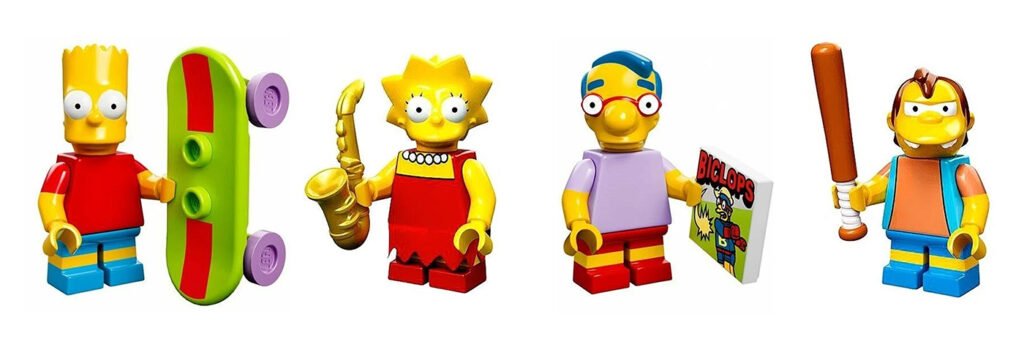
2012 saw the first special series with Team GB’s nine commemorative minifigure release celebrating the London Olympics1. Two years later, two more special series were released with The LEGO Movie Series 1 (January) and The Simpson Series 1 (May), and it was with this series that we first saw LEGO pushing their technical prowess with Bart and Lisa Simpson’s striped legs. In fact, these short legs were tri-molded and the same mold was used for Milhouse and Nelson Muntz.
So what are dual-molded legs?
The process sees an injection mold that would normally be filled once with one colour – which up until 2014 had been the case for all LEGO legs – instead hit with two different colours which fuse together to create 360˚ permanent colour without any ink printing.
The Simpson’s short legs were a natural stepping off point as they do not have the same articulation as standard sized legs do, so the layered colour was an ideal method to show layers of colour where printing would be near-impossible.
The real benefit of this is full, rich 360˚ colour. Remember that side printing on legs only started in 2010 with CMF’s Cheerleader.
Bart, Lisa, Milhouse and Nelson all have striped legs, meaning a blast of colour one, a second blast of colour two, and a finishing another blast of colour 1 with each colour fused to the other. Not only that, but Bart’s arms were also dual-molded, mimicking his t-shirt sleeves, which extended to Milhouse (lilac/yellow), Homer (white/yellow) and Itchy (orange/sand blue).
Technically correct
Within the injection moulded world, the process is technically called two-shot, dual-shot, multi-shot or double-molded injection2. In essence it allows for multiple colours to be injected into one part without adding an extra assembly steps, such as a second mold. It’s also strong. Commercially, two-shot molding is used for hard wearing items such as power tool grips, hinges and gaskets3. For this article though, we’ll stick with language of ‘dual-molded’ as that’s become the accepted term within the LEGO community.
So, if The Simpsons were the first short-legs, but really they were tri-molded, who sports the first standard dual-molded legs? There’s references out there to 2015 Batman (sh0024) was the first, but his legs were printed on each side, so that honour instead goes to the 2015 Comic-Con exclusive Sam Wilson Captain America (sh0208).
Spider-Man (sh0205), released in June of 2015, was the first commercially-available release for LEGO fans, and used the exact same legs as the Comic-Con exclusive – red at the bottom and blue at the top.
In September of the same year, dual-molded legs appeared in CMF Series 14 with the Monster Scientist (col213), this time with white legs and black boots.
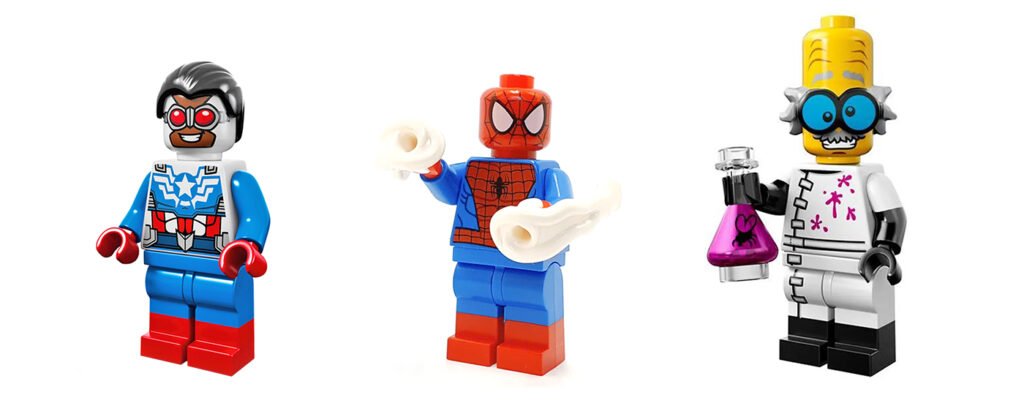
2015s first three dual-molded minifigures; Comic-Con exclusive Sam Wilson Captain America (sh0208); Spider-Man (sh0205), and Monster Scientist (col213).
Fan favourites
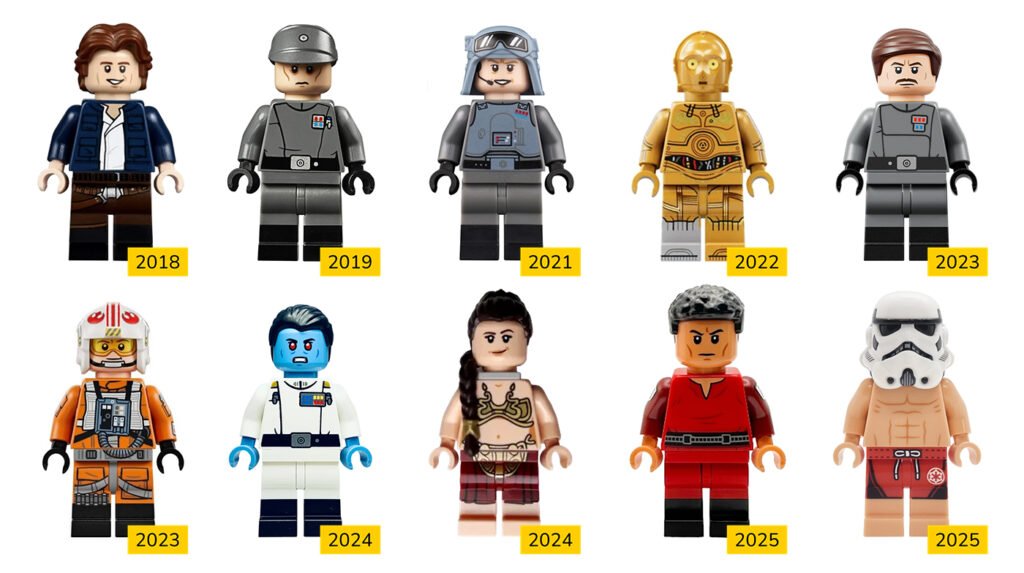
Fans have grown to love dual-molded legs as they offer clean, more realistic feel, such as boots, multicoloured legs or distinct shoe variants, such as Star Wars’ C-3PO’s gold and silver alternate legs (sw1209) with detailed leg printing which also came out as a popular keyring.
Some minifigures lend themselves perfectly to dual-molded legs such as several variants of Spider-Man; the short-legged Hobbits who were originally released with single colour short legs, but were upgraded for set 10354 The Lord of the Rings: The Shire™; and 27 different minifigures which share the same the dark blueish grey top and black boot variation including Batman, numerous Star Wars officers, Castle Knights, Black Falcons, Spider-Man (Miles Morales), Frankenstein’s Monster (BAM) and the Christmas Nutcracker.
Breaking the clean horizontal line
In almost all cases, the line between colours is horizontal and clean cut across the front (and always following the stud curve at the rear), but not always. Sometimes characters come along that require the process to be re-invented, and that’s the case for two stand out minifigures; Toy Story’s Woody (toy003) and Shrek’s Thelonious (CMF Shrek, colshr01)
Woody’s boots introduce a lovely v-shape brown boot tops that connect to his blue jeans, while Thelonious’s legs have an upside-down V-shape black boots folded into light blueish grey legs (part 970c86pb45).
More unusual still is part 970d54pb01, which has one standard leg combined with a dual-molded black and flat silver prosthetic leg for Echo (Marvel Studios CMF Series 2, colmar21), who also has dual-molded arms.
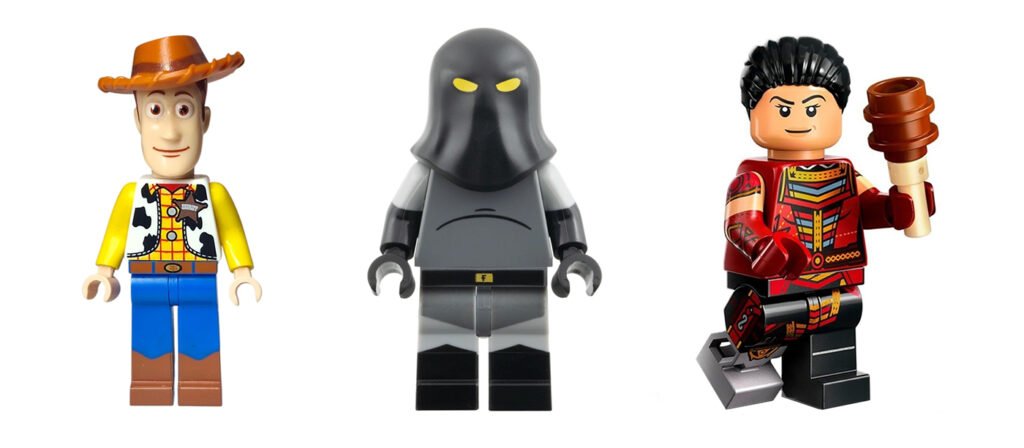
Woody, Thelonius and Echo – unusual dual-moldings.
So what about over-molding?
There is a two (or more) step, sequential, injection molding technique called over-molding whereby one element is – literally – molded on top of another. Think NINJAGO headgear, the Hot Tub Stormtrooper’s helmet, and Zeb Orrelios’s head. Unlike dual-molding where multiple colours are injected into the same mold, over-molding is a process where one part is formed from two (or more) different molds.
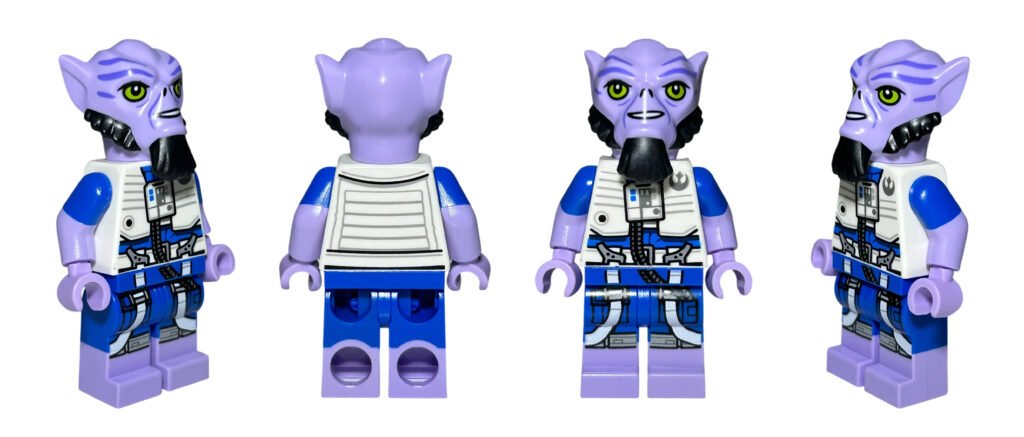
Zeb Orrelios – Republic Flightsuit (sw1527) is the first Star Wars minifigure with dual-molded arms, legs and over-molded head. This even has printing on the legs.
The first such element to use over-folding is the 2008 Crystal Skull piece for the Indiana Jones Kingdom of the Crystal Skull set. Using two-shot over-molding, the first injection mold was the blue plastic brain, which then moved over to a second, larger cavity mold where the trans-clear skull was formed around it4. The process is technically hard as piece alignment is paramount, but given LEGO’s famed exacting tolerances, this type of process is baked into what the company does.
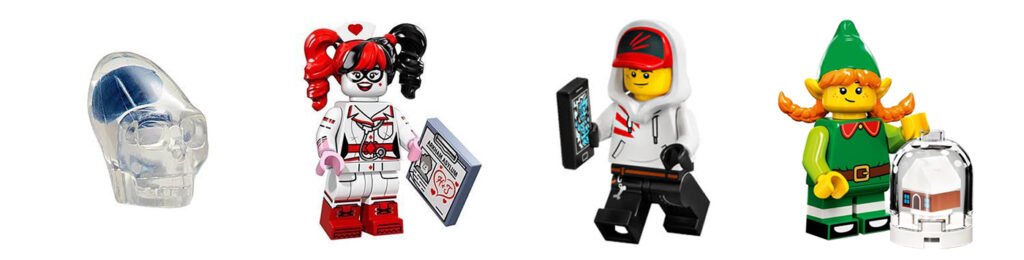
Common over-molded examples include several variations of two-tone, dual pigtail hair such as Cotton Candy Cheerleader and Harley Quinn; elf-like ears and beanie combos for Green Goblin and Christmas elves; hat/hoodie combo for 2020’s NINJAGO’s Scott, Hidden Side’s Jack Davids (who also has a dual-molded hat/hair combo); and numerous NINJAGO masks such as Nya (see picture).
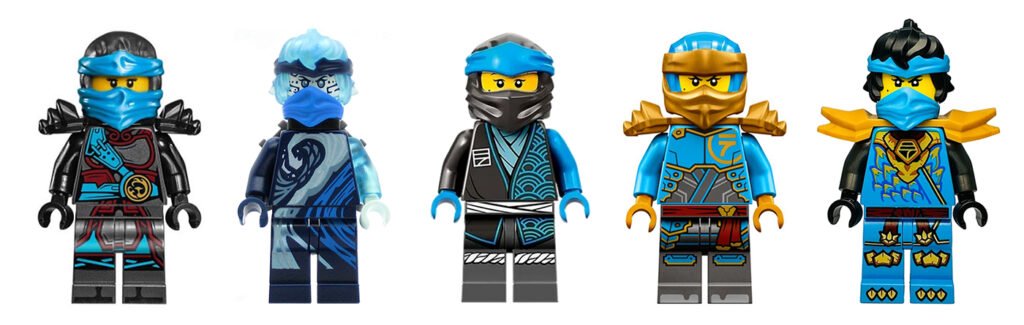
Again, in LEGO community vocabulary, both techniques are referred to as dual-molding.
It’s not just LEGO who have embraced this technique, with third-party specialists, such as Brick Tactical, making over-molded weapons and accessories, including a whole set of workshops tools including drills, pliers and staple guns, and their triple-molded, highly detailed, Call of Duty Zombies-style BT3 Wunderwaffe5.
Go back even further – 2002 – and LEGO had used two different materials in the same mold for the Bionicle Bohrok head-shields, which combined hard and rubbery plastics together. These pieces often have a marbled look where the materials blend, rather than the clean cut dual-molded legs.
It’s argued that there are some classic LEGO 1x3x3 doors – as early as 1967 – that are dual-molded, with a bold colour across 2/3rds of the bottom, and trans-clear across the top6, but they were not7. The 1967 version was a single piece of trans-clear plastic that was then painted on the front only, while a later variant (said to be around 1973) – distinguished by the door handle being horizontal rather than vertical – had a trans-clear top that was fused to the solid bottom.
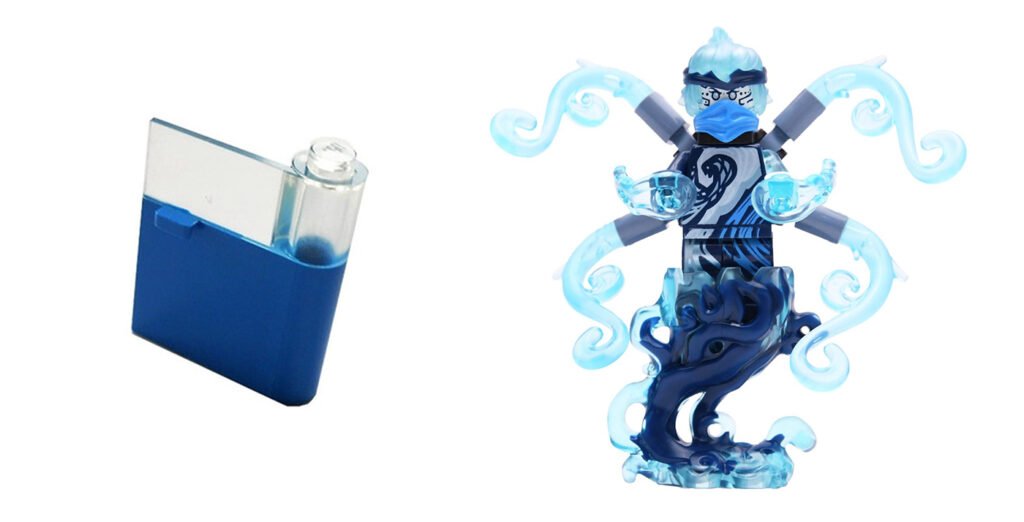
Almost 50 years apart – a Classic 1x3x3 two-part door (circa 1973) alongside the 2021 dual-molded headpiece Nya NRG Seabound, which also has a over-molded swirling leg pieces with marble effect.
Hans Schiess and The LEGO® System of Play
Injection molding transformed LEGO from wooden toy manufacture to plastic brick powerhouse. Since 1953, LEGO had housed their own injection molding machines and in 1959 opened LEGO Form in Vejle, about 30km from Billund, which starts LEGO’s quest for precision, and just a year later for the company to formerly concentrate it’s efforts solely into the LEGO® System of Play.
That was cemented with the 1961 hire by Godtfred Kirk Christiansen of Swiss plastic molding expert, Hans Schiess, who became LEGO’s driver behind LEGO molding philosophy, the so-called PE method, where the company switched from cellulose acetate (based on wood) to the more stable and colour-fast ABS (acrylonitrile‑butadiene‑styrene). The switch allows LEGO greater precision – done to an accuracy of 1/200mm – and under Schiess’ care, allowing for a far wide range of parts of be created to the highest possible standards8. Indeed, it’s widely known that LEGO bricks from 30, 40, 50 years ago still fit today’s bricks, and that all started in the early 60s.
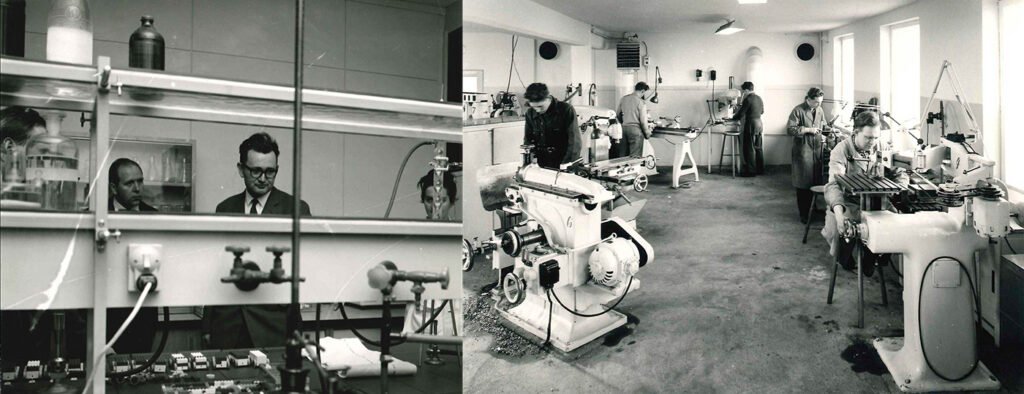
1963 – Hans Schiess, LEGO Form, Vejle (left). 1957 – Moulding shop, Billund (right). Copyright The LEGO Group.
Sources:
- Jay’s Brick Blog – Team GB ↩︎
- Sdyney Molding – Two-shot molding cv overmolding ↩︎
- Mid State Mold – Differences Explained ↩︎
- Brickowl – 2008 Crystal Skull with Blue Brain ↩︎
- Brick Tactical – BT3 wunderwaffe ↩︎
- Reddit – First dual-molded parts ↩︎
- 62Bricks – 1x3x3 classic doors ↩︎
- History of The LEGO Group – LEGO Molding Philosophy ↩︎