

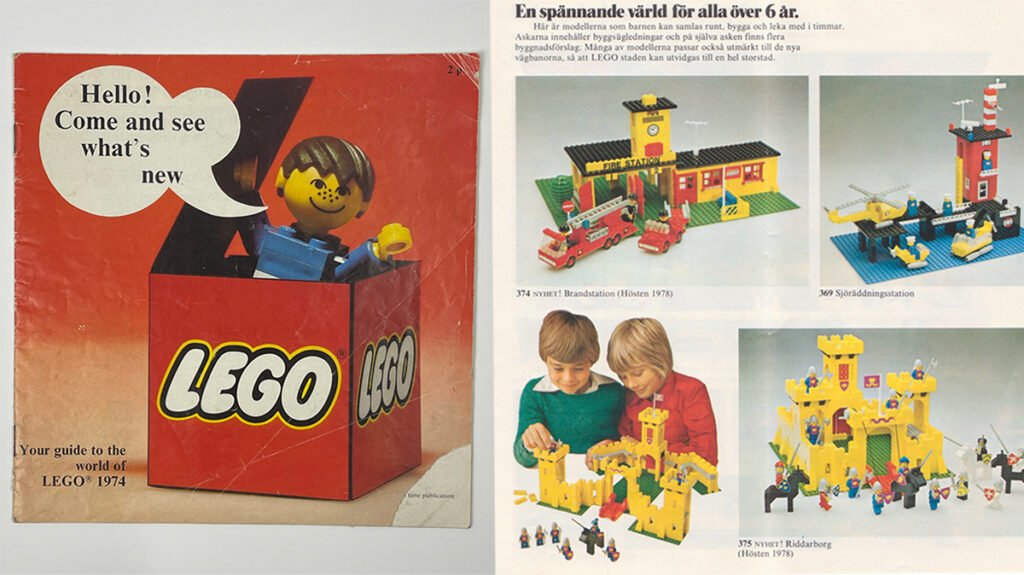
From Homemaker heads and maxifigures to Pirates, Jedi, and 19,000 unique characters – the story of the world’s most recognised toy figure.
The LEGO minifigure is so familiar today that it feels almost inevitable – an icon whose proportions, smile, and clutching hands are etched into collective memory. Yet the figure we now recognise as the heart of the LEGO System of Play was the result of many years of experimentation, iteration, and bold design decisions. Its history is not merely one of scale and plastic, but of philosophy: how to give life, personality, and narrative to bricks.
Before the Minifigure – Maxifigures and Homemakers
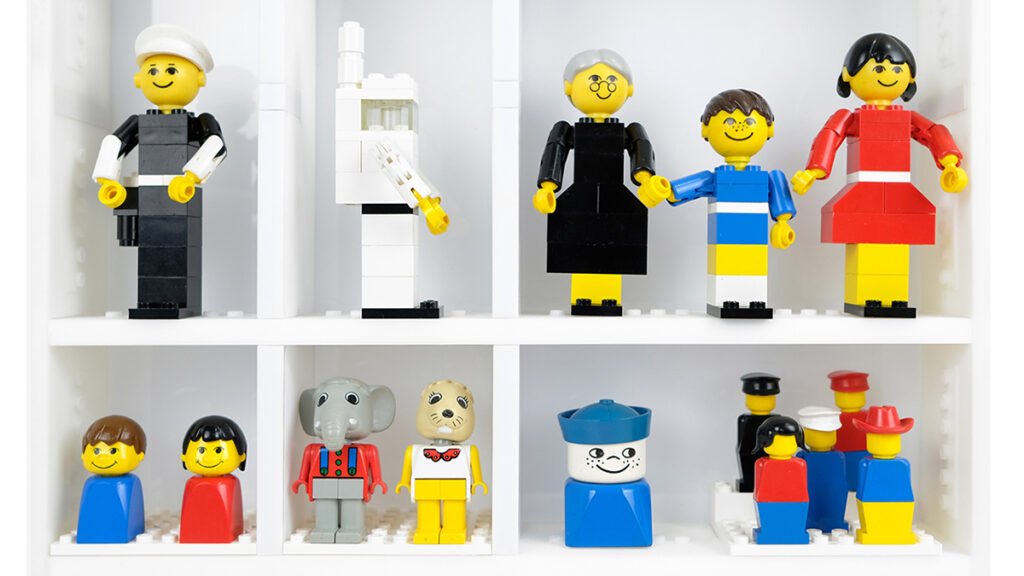
Long before the minifigure appeared, LEGO was already exploring the idea of representing people within their building sets. In the early 1970s, sets such as 565 LEGOLAND Moon Landing introduced what collectors now call ‘maxifigures’ – larger, blockier figures eight bricks high, whose heads were 2×2 bricks that could be swapped for 2×2 clear bricks to transform them into astronauts. These figures used the rounded Homemaker-style head – part 685px4 – a smooth, featureless cylinder that conveyed ‘human’ without expression. The head connected via a Technic-style neck element that clipped into part 792c03, a torso piece with provision for jointed arms and rounded stud hands.
At the same time, LEGO’s Homemaker series, launched in 1974, pushed further. Sets like Set 200 Family featured figures with movable arms, removable hairpieces, and bodies constructed from standard LEGO bricks. These figures were expressive in their own way and enormously successful, but they revealed key limitations. They were large, their legs did not move, and they lacked seamless integration with the broader building system. LEGO had people. But not yet characters.
Set 370 – The First True Minifigure Prototype
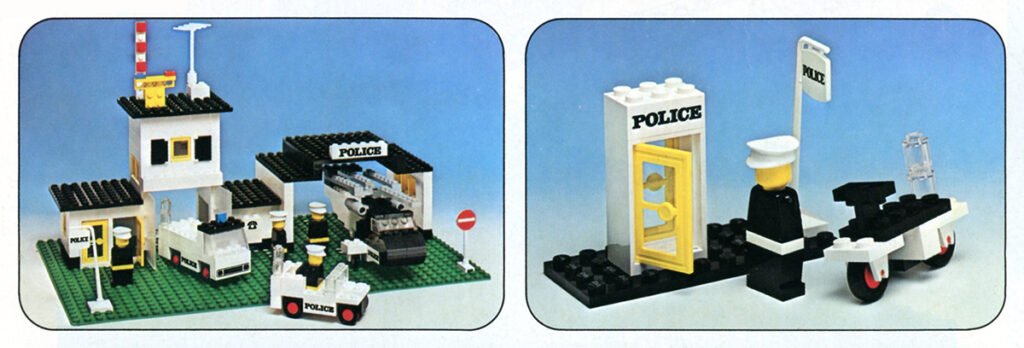
A pivotal step came with set 370 Police Headquarters, which introduced the first figure at the same scale as the modern minifigure: a policeman. By today’s standards, he was primitive – no printed face, no printed torso, immovable arms moulded directly into the body, and tapered, solid legs that could not walk. He wore a specially moulded white police hat.
And yet, this figure changed everything. For the first time, the feet could attach securely to LEGO studs. That simple act – standing firmly within the brick-built world – made the figure a revelation. The figure was no longer an accessory. It was part of the system.
Jens Nygaard Knudsen and the Birth of the Modern Minifigure
The leap from that early figure to the fully articulated minifigure we know today belongs largely to Jens Nygaard Knudsen, who, alongside Godtfred Kirk Christiansen, co-patented the LEGO minifigure in 1978. Knudsen believed deeply that children needed characters to inhabit their creations – figures that could drive stories, conflict, and imagination.
The road to that patent was long. Numerous prototypes explored different leg mechanisms, arm shapes, and head designs. Some were too fragile, others too complex. Ultimately, Knudsen’s solution was elegant: a figure with movable legs and arms, hands curved to grip accessories, and proportions that balanced realism with abstraction. This design was protected under U.S. Design Patent USD253711S and Australian patent 5006003, securing the minifigure’s place in toy history.
It took Knudsen and his team three years to design the original lineup of minifigures. Today, remarkably, each new minifigure design can still take up to a year to move from concept to final production – testament to the precision and care involved.
1978 – Castle, Space, and Town
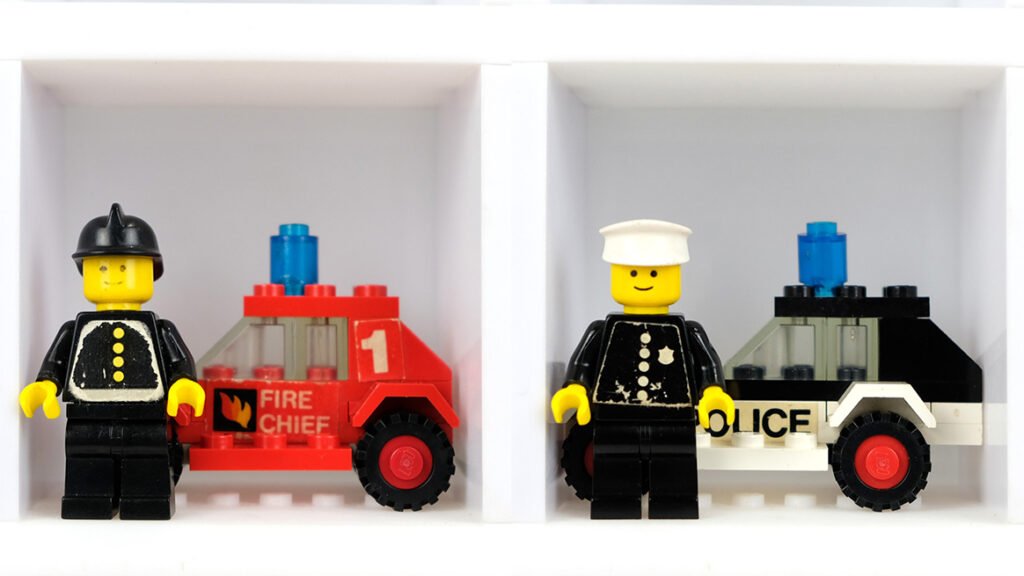
The modern minifigure debuted in 1978 alongside the Castle, and Town themes – all designed by Knudsen. Suddenly, LEGO worlds felt alive. Knights could defend walls, astronauts could explore alien landscapes, and townspeople could populate streets and stations.
The very first minifigure, a policeman from Set 600, featured movable legs, a pad-printed face, and a torso sticker – simple, but revolutionary. The policeman was chosen as a trusted community figure and natural leader. The role also had a practical design advantage: the minifigure could wear a hat. At launch, only hats and pigtails were available as headpieces, and it was not until the following year that a male hairpiece was produced. An updated version of that original hair piece is still used today – on characters such as Luke Skywalker in his Return of the Jedi appearance, and young Tim Murphy from Jurassic Park.
Early Space minifigures in white and red introduced distinctive helmets and air tanks that fitted over the neck of the torso, reinforcing the idea that minifigures could support specialised gear. With their universal smiling face, these figures were deliberately neutral – allowing children to project any emotion or story they wished.
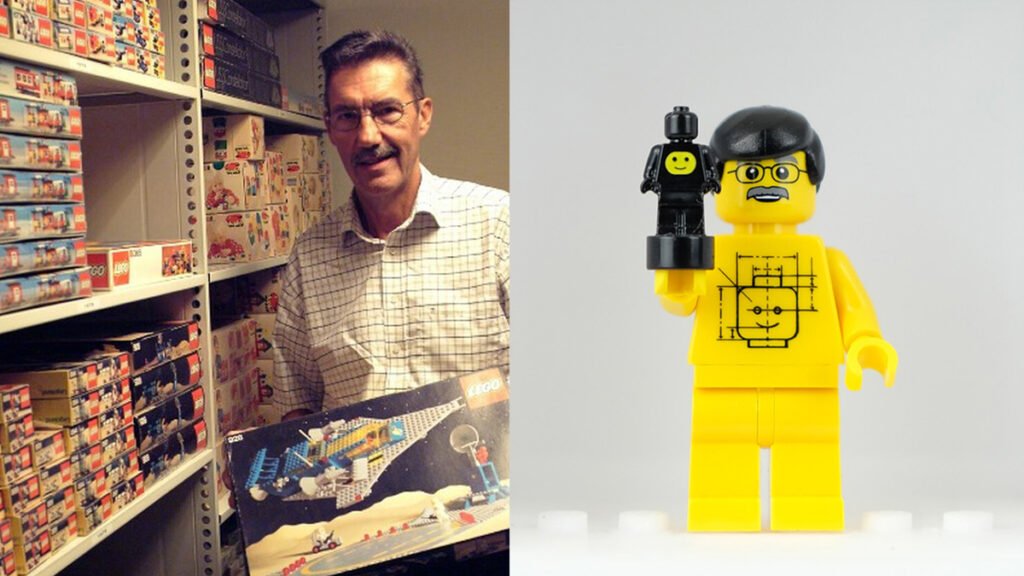
| Why yellow? LEGO’s choice of yellow for the original minifigure face was deliberate and considered. The colour was intended to be ethnically neutral – a blank canvas for any character or story, avoiding the assignment of a specific race. Yellow was also bright, cheerful, and instantly recognisable, aligning with LEGO’s playful identity. The minimalist expression – dot eyes, simple smile – kept production simple while maximising imaginative projection. From 2003 onwards, the introduction of licensed themes such as Star Wars and NBA made realistic skin tones necessary to represent specific characters accurately. By 2004, diverse skin tones had become standard for licensed minifigures. Today, yellow heads remain the convention for original LEGO themes – City, Space, Pirates, Ninjago – while flesh-toned heads appear in licensed and character-specific sets. The classic yellow face endures as one of the most recognised design decisions in toy history. |
Accessories and Integration
The creation of the minifigure unlocked an entirely new design language. Accessories could now be made specifically for hands and bodies: the original police radio that clipped into the hand’s clutch, tools, weapons, and eventually vehicles. By 1984, Set 6684 Police Patrol Squad introduced the first motorcycle scaled so that a minifigure could actually sit on it. This seamless integration of figure and environment cemented the minifigure as the linchpin of LEGO play.
1984 was also a significant technological milestone for LEGO. Advancements in ABS plastic injection molding (from which all plastic LEGO elements are formed) took a seismic leap forward with the advent of the slide mold. This was different from the top-down molds used for standard LEGO bricks, as it uses multi-part injection mold architecture to create such pieces as a knights helmet.
Slide mold differ as after teh plastic has been injected, and before it cools, mechanical ‘slides’ or ‘slide-cores’ pop out laterally to hollow out the interior to any shape.
This new machinery and techniques lead directly to the innovative parts that were core to teh new Pirates theme, with Captain Red Beard at it’s helm.
Minifigure Firsts – Captain Red Beard
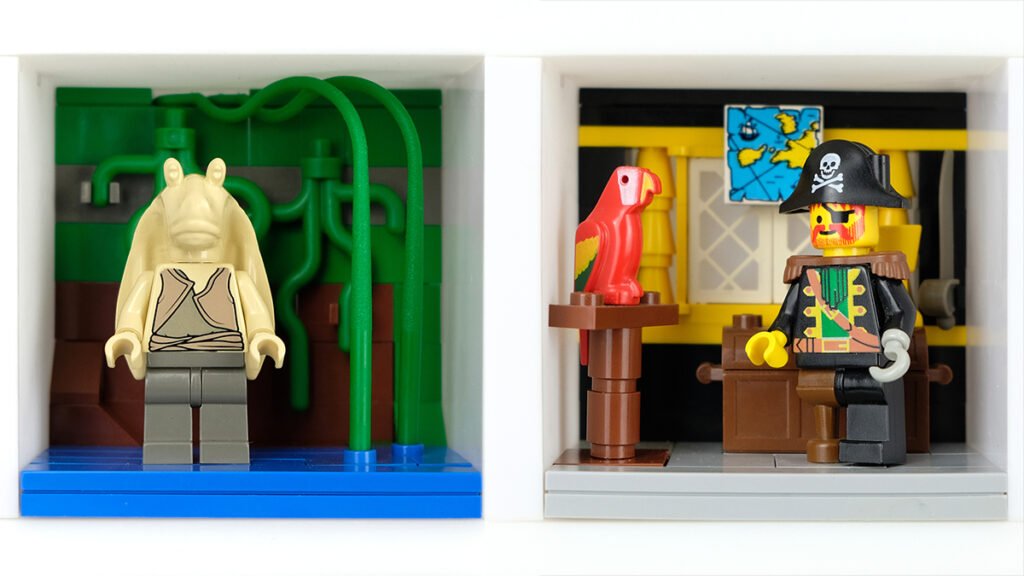
For over a decade, all minifigures shared the same smiling face – iconic, but limited. That changed in 1989 with the arrival of the Pirates theme and Captain Red Beard. Red Beard introduced the first detailed face: a pad-printed beard and eyepatch. He also sported a wooden peg leg and a hook hand – the first deliberate departures from standard minifigure anatomy. LEGO characters could now show individuality, history, even imperfection.
Star Wars and the Expansion of the Possible
In 1999, LEGO Star Wars changed the minifigure permanently. The need to represent non-human characters with precision drove a wave of innovation that reshaped what a minifigure could be.
Yoda introduced short legs for characters of smaller stature – a solution so elegant it has since been used for dozens of characters across multiple themes. Jar Jar Binks in 1999 became the first minifigure with a specially sculpted head mould, opening the door to non-humanoid characters that could not be represented with the standard round head. Chewbacca, in 2000, went further: not only a custom headpiece, but an integrated chest piece covering both front and back, creating the first fully body-specific minifigure construction.
R2-D2, also from 1999, took a different approach entirely – assembled from two existing LEGO elements repurposed with characteristic ingenuity: a round 2×2 dome and a 2×2×2 robot body with legs using the same pin connection widely used in LEGO Technic. A beloved character built entirely from existing parts.
The 2000s followed with double-sided face printing – first appearing on Professor Quirrell in 2001, allowing a single figure to express two different emotions – and detailed leg printing that pushed character storytelling further than any previous innovation. See our appendix of minifigure firsts for the full timeline.
Pad Printing – Precision and Permanence
Central to this evolution was pad printing: a technique that allows highly precise ink transfer onto curved and uneven surfaces. A silicone pad picks up ink from an etched plate and presses it cleanly onto the plastic element. The method is exceptionally durable and accurate – which is why it is also used for watch faces, medical instruments, electronics, and ceramics.
For LEGO, pad printing started in 1974 following the acquisition of pad (tampo) printing machines. Before these machines, adding details to any plastic form could only be done on completely flat surfaces. Tampo machines use a flexible silicone pad to transfer a 2D inked image from an etched plate onto 3D objects with curved, textured, or irregular shapes, such as minifigure heads. This was the only option to produce those classic smiling faces, and LEGO invested heavily into them.
For LEGO, pad printing ensured that facial expressions, uniforms, and insignia would last through years of play. Its longevity and detail are a key reason minifigures from the 1980s still look crisp today – and why it eventually replaced sticker-applied torsos entirely.
Minidolls and New Audiences
In 2012, following four years of research, LEGO introduced the Minidoll, pioneered for LEGO Friends. Taller, slimmer, and more anatomically styled, Minidolls were the result of extensive research into play patterns and character identification. While distinct from minifigures, they reflected the same core philosophy: figures matter because stories matter.
Collecting and Cultural Impact
Today, minifigures are not just toys – they are collectibles. According to BrickLink, there are 19,166 individual minifigures catalogued, a number that has famously surpassed the human population of Earth. LEGO’s announcement that total minifigure production had exceeded the global population was a quiet but profound marker of cultural reach.
In 2010, LEGO embraced this passion directly with the launch of Collectable Minifigures – blind-bagged series that encouraged figure-only collecting for the first time. Each series originally contained 16 figures. Then came Series 10, which added a seventeenth: Mr. Gold. Produced in a run of just 5,000 worldwide and distributed randomly within blind bags, Mr. Gold became one of the most sought-after and valuable modern minifigures ever produced – a single figure that crystallised everything the collecting community felt about rarity, chance, and the thrill of the hunt.
| 19,166* and counting… BrickLink currently catalogues 19,166 individual LEGO minifigures – a number that grows with every new set release, but it’s not right. But it is. In that figure are ‘minifigures’ that LEGO themselves say are not – such as skeletons, droid, DUPLO, Belville and many many more. In addition, there are items for deletion, and then ‘a’ and ‘s’ variations of a minifigures that have stickers applied, or not. In LEGO’s own A Visual History, they also discount minidolls from that 19,000 figure as – well – they’re Minidolls not minifigures. So how many minifigure are there? No idea, but they will ALL fit inside a singular (if somewhat oversized) Finity Frame. *As September 1, 2026 |